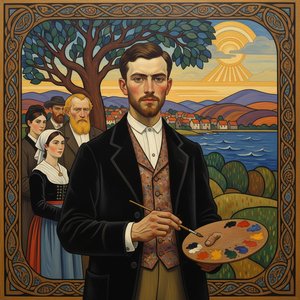
Émile Bernard: A Post-Impressionist Pioneer
Early Life and Education
- Born: April 28, 1868, in Lille, France.
- Émile Henri Bernard’s early life was shaped by his sister's illness, leading to him being raised primarily by his grandmother, who ran a laundry in Lille. This supportive environment fostered his artistic inclinations.
- In 1878, the family relocated to Paris, where Bernard attended the Collège Sainte-Barbe.
- He began formal art studies at the École des Arts Décoratifs and later joined the Atelier Cormon in 1884. Here, he experimented with Impressionism and Pointillism.
- His expressive tendencies led to a suspension from the École des Beaux-Arts, prompting a formative journey through Brittany on foot.
Artistic Development and Influences
- Bernard’s artistic development was significantly influenced by his travels in Brittany, where he encountered local traditions and landscapes that deeply resonated with him.
- Key Relationship: A pivotal moment came in August 1886 when he met Paul Gauguin in Pont-Aven. This encounter sparked a close artistic friendship and profoundly impacted both artists’ styles.
- Bernard's style played a crucial role in shaping Gauguin’s mature work, particularly his exploration of symbolism and flattened forms.
- He also associated with Vincent van Gogh, forming part of the “School of Petit-Boulevard” alongside Anquetin and Toulouse-Lautrec.
Key Artistic Movements
- Cloisonnism: Bernard is considered a pioneer of Cloisonnism, a style characterized by bold, flat shapes separated by dark contours – reminiscent of stained glass.
- Synthetism: He also played a key role in the development of Synthetism, which emphasized the creation of art based on subjective experience and symbolic meaning rather than direct observation of nature.
- These movements represented a departure from Impressionism, focusing instead on structure, symbolism, and emotional expression.
Notable Works
- La Grandmère (1887): A poignant portrait of his grandmother, showcasing the artist’s early mastery of expressive form and color. This work is considered one of his most iconic pieces.
- Numerous Breton landscapes capturing the essence of rural life in Brittany.
- Religious works such as “The Adoration of the Shepherds” demonstrating his exploration of symbolic themes.
Literary Contributions and Historical Significance
- Beyond painting, Bernard was a prolific writer, producing plays, poetry, and art criticism. His writings provide valuable first-hand insights into the development of modern art during his time.
- Legacy: Émile Bernard’s contributions to Post-Impressionism, particularly his role in shaping Cloisonnism and Synthetism, left a lasting impact on the course of modern art.
- His work paved the way for subsequent movements like Fauvism and Expressionism, influencing generations of artists to explore subjective expression and symbolic representation.
- He died in 1941, leaving behind a body of work that continues to be celebrated for its originality and artistic innovation.
Questions & Answers
Can I browse Émile Bernard's works by color palette?
The By Palettes page groups Émile Bernard's artworks by their color palettes.
How can I see every artwork made by Émile Bernard?
Every work by Émile Bernard on this website can be browsed from the artist's All Artworks page.
Is there a timeline of Émile Bernard's works?
The artist's Artwork Timeline page presents Émile Bernard's works ordered by date, year by year.