

1


Updated November 2026 · ranked by our popularity score (searches, visits and orders for each work) · 6 works by Jan Juriaensz. van Baden in our catalogue
Summary
The most widely known painting by Jan Juriaensz. van Baden is View of a Manor House (1638), in the collection of the Statens Museum For Kunst, Copenhagen. The next entries are Interior of the Nieuwezijdskapel in Amsterdam during a service (1658) and Interior of a Church (1641). The catalogue documents 6 works by Jan Juriaensz. van Baden; the 5 entries below are the best known, listed in rank order with date, holding museum and description.


Jan Juriaensz. van Baden presents the grand interior of a classical church in this work from about 1641. The scene captures a vast, hollow space defined by massive architectural elements. Within the nave, several small human figures are scattered, their diminutive scale emphasizing the immense volume of the structure. These figures provide a sense of proportion to the soaring vaults and heavy stone columns.


The 2 museums that hold the most of the paintings on this page.
| Museum | City | Works by Jan Juriaensz. van Baden | Paintings from this list |
|---|---|---|---|
 Statens Museum For Kunst |
Copenhagen | 3 | View of a Manor House, Interior of a Church, Church Interior |
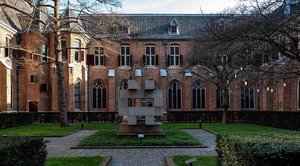 Museum Catharijneconvent |
Utrecht | 1 | Interior of the Nieuwezijdskapel in Amsterdam during a service |
Select a decade to display its principal painting.
Jan Juriaensz. van Baden presents the grand interior of a classical church in this work from about 1641. The scene captures a vast, hollow space defined by massive architectural elements. Within the nave, several small human figures are scattered, their diminutive scale emphasizing the immense volume of the structure. These figures provide a sense of proportion to the soaring vaults and heavy stone columns.
View of a Manor House (1638), Statens Museum For Kunst, Copenhagen. The following entries are Interior of the Nieuwezijdskapel in Amsterdam during a service (1658) and Interior of a Church (1641).
34 years: Jan Juriaensz. van Baden was born in 1604 and View of a Manor House is dated 1638.
The catalogue records 6 works by Jan Juriaensz. van Baden, dated between 1638 and 1658.
Principally in Statens Museum For Kunst (Copenhagen) and Museum Catharijneconvent (Utrecht). The museum table above gives the full distribution.
In 1640s: 3 of the 5 works listed on this page are dated to that period, including Interior of a Church.
The earliest dated work listed here is View of a Manor House (1638); the latest is Interior of the Nieuwezijdskapel in Amsterdam during a service (1658).
View of a Manor House, Interior of a Church and Church Interior are among the 3 works on this page in the collection of the Statens Museum For Kunst, Copenhagen.
Before he was a painter of grand spaces, Jan Juriaensz. van Baden lived a life of physical labor. Born in Steinbach, Germany, in 1604, his early years were spent as a sailor. This time on the water likely shaped his understanding of light and vastness, though his true calling emerged much later. By 1633, he was settled in Arnemuiden, where he married Jannetje van der Meer. His life was marked by the rhythms of domesticity and the necessity of starting anew; he would marry three more times, eventually finding his final home in Amsterdam, where he lived until his death in December 1677.
His transition from the sea to the studio was a profound shift in perspective. While the details of his formal training remain somewhat obscured by time, it is believed he studied under Dirck van Delen during his years in Arnemuiden. This mentorship provided the foundation for a career dedicated to the geometry of the built environment. He moved from the coastal life of Arnemuiden to the bustling center of Amsterdam in 1635, a move that would define the rest of his professional existence.
Van Baden found his niche in the specialized world of architectural painting. He did not seek to capture the chaos of the street, but rather the stillness of the interior. His work often focused on the hollow, echoing spaces of churches, where light filtered through high windows to touch stone and wood. He had a particular way of handling perspective, often working with narrow naves and a forest of columns that drew the eye deep into the composition. Over time, his style evolved from the rigid, tunnel-like views of the early seventeenth century toward compositions that felt more open and airy.
His technical approach was characterized by several distinct elements:
While some of his contemporaries began experimenting with more complex, double-point perspective, van Baden remained loyal to a more traditional, singular focus. He was content to explore the quiet tension between the weight of stone and the lightness of the air surrounding it. His paintings were not merely records of buildings, but studies in how space feels when it is left unoccupied.
The works of Jan Juriaensz. van Baden survived through the centuries, finding their way into significant collections. His ability to translate the scale of a palace or the solemnity of a cathedral onto a wooden panel allowed him to leave a permanent mark on the Dutch Golden Age. His paintings, such as those found in the Staatliches Museum in Schwerin or the Statens Museum for Kunst in Copenhagen, show a man who understood the dignity of structure. He captured the way a building holds its breath, creating a sense of stillness that remains palpable in his surviving canvases.