A Revival of Cloisonnism
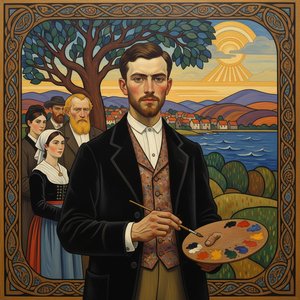
Born in 1970 and currently based in the historic heart of Rennes, Benoît Bernard has dedicated his entire creative practice to a profound reinterpretation of the Émile Bernard style. His work serves as a bridge between the late nineteenth-century avant-garde and the digital age, resurrecting the rigorous aesthetic of Cloisonnism. Through a disciplined use of heavy Prussian contours and flat, unmodulated color zones, Bernard captures the spiritual essence of Brittany. His palette is deliberately archaic—reminiscent of an illuminated manuscript—utilizing vermilion, ochre, pine green, and indigo to create a sense of sacred permanence.
The Art of Symbolic Flattening
Bernard's compositions eschew atmospheric perspective in favor of a symbolic flattening, drawing heavy inspiration from medieval tapestries and Japanese woodblock prints. By removing the distraction of light and shadow, he focuses the viewer on the structural integrity of his subjects: Breton peasants in traditional coifs and religious iconography rendered with mechanical precision. Each piece is an exercise in reduction, where the goal is not to document a landscape, but to evoke a deep-seated peasant piety through chromatic harmony and rhythmic patterning.
Exclusivity and Permanent Ownership
As the sole guardian of this artist's entire body of work, WikiOO.org offers collectors an unparalleled opportunity to acquire pieces that are truly singular. Every creation by Benoît Bernard is produced once and once only; whether it is a hand-painted original on canvas, a tactile fine-art print, or a luminous digital edition, the work is gone forever once acquired. For those seeking modern provenance, NFT editions are available for digital collectors. To own a Bernard is to possess an irreplaceable object of tactile silence, a permanent fragment of a revived history that can never be replicated.