Dogon People: Masters of Wood Sculpture and Ancestral Beliefs
The Dogon people, hailing from the central plateau region of Mali in West Africa, stand apart as a cultural enigma celebrated for their distinctive artistic traditions—primarily intricate wood sculptures and mesmerizing masks—rooted deeply within complex cosmological beliefs. Their language, Dogon, is considered an independent branch of the Niger-Congo family, signifying its divergence from other African languages and fostering a unique linguistic identity. Beyond mere aesthetics, Dogon art serves as a conduit for conveying profound spiritual narratives and preserving ancestral knowledge passed down through generations.
Their artistic heritage stretches back millennia, yet it’s only in recent decades that scholars have begun to unravel the mysteries surrounding their worldview and creative practices. Situated amidst dramatic canyons and fertile valleys—a landscape profoundly shaping their perception of reality—the Dogon villages are meticulously organized around sacred groves known as “petri,” which serve as focal points for communal rituals and symbolize the connection between humanity and the cosmos. These petri, adorned with symbols representing ancestral spirits and celestial bodies, represent a cornerstone of Dogon spirituality and inform every aspect of their artistic expression.
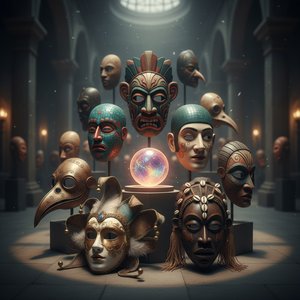
The Dogon’s cosmology depicts nine celestial spheres inhabited by spirits—a concept central to their religious beliefs—each influencing earthly affairs. This hierarchical structure mirrors the Dogon’s understanding of the universe and is vividly portrayed in their masks, which embody ancestral figures and depict mythological narratives. The meticulous craftsmanship involved in mask creation reflects a deep reverence for tradition and underscores the importance of preserving ancestral knowledge. These masks are not merely decorative objects; they are instruments of ritual transformation, facilitating communication with the spirit world and reaffirming social cohesion.
Dogon sculpture is renowned for its remarkable precision and stylistic conventions. Artists employ a technique known as “petri-carving,” utilizing obsidian tools to sculpt stylized figures from acacia wood—a material chosen specifically for its durability and symbolic association with permanence. The geometric abstraction characteristic of Dogon sculptures—evident in forms like the Gomintogo mask—reflects the Dogon’s grasp of spatial relationships and mirrors the celestial spheres, mirroring their cosmological vision. These sculptures are imbued with spiritual significance, conveying narratives about creation myths and ancestral lineages.
The influence of Dogon art extends beyond its immediate cultural context, captivating artists globally. Yves Saint Laurent famously incorporated Dogon textile patterns into his haute couture collections, demonstrating the enduring appeal of Dogon’s aesthetic principles. Furthermore, ongoing research continues to illuminate the intricacies of Dogon cosmology and artistic traditions, ensuring that this extraordinary cultural heritage remains accessible to future generations. The Dogon people's contribution to African art history is undeniable, securing their place as visionary artists who have captivated audiences worldwide.
## Notable Achievements & Artistic Influences
The Dogon’s artistic legacy extends beyond individual sculptures and masks; it embodies a holistic worldview that informs every creative endeavor. Their geometric abstraction—evident in both sculpture and textile designs—anticipates modernist tendencies while simultaneously reflecting the Dogon’s profound engagement with celestial observation. The Gomintogo mask, considered one of the most iconic representations of Dogon spirituality, exemplifies the meticulous craftsmanship and symbolic depth characteristic of Dogon art. Its intricate carvings convey narratives about creation myths and ancestral lineages, demonstrating the power of visual imagery to communicate complex ideas.
## Exploring Dogon Art Further
For a deeper understanding of Dogon culture and artistic traditions, consider visiting the Visionary Artists / Dogon Style exhibition at the National Museum of African Art in Washington D.C., or delving into Smarthistory’s analysis of “Dogon Couple.” These resources offer valuable insights into Dogon cosmology, sculpture technique, and the enduring significance of ancestral beliefs. Furthermore, exploring museums like the Museum of the Galician People and Peoples History Museum provides comparative perspectives on artistic expression within diverse cultural contexts.