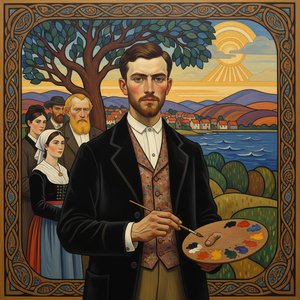
The Versatile Hand of Jacques-Samuel Bernard
In the vibrant, sun-drenched era of seventeenth-century France, few artists navigated the shifting tides of artistic medium and religious identity as gracefully as Samuel Bernard. Born in Paris in 1615 to a Protestant family, his life was a testament to the enduring power of talent amidst social upheaval. As the son of the painter Noel Bernard, he was immersed in the language of color and form from birth. His early training under masters such as Simon Vouet and Louis du Guernier provided him with a robust foundation in the grand traditions of the French Baroque, allowing him to begin his career amidst the sweeping, dramatic expanses of fresco painting.
Yet, Bernard was not content to remain within the confines of large-scale murals. He possessed an exquisite sensitivity for the minute and the delicate, leading him to transition into the intimate world of miniature painting. This shift required a profound mastery of precision, as every brushstroke in a portrait miniature must carry the weight of a much larger canvas. His ability to capture the subtle nuances of human expression within such a restricted space earned him significant prestige, eventually leading to his appointment as a professor at the Académie Royale de Peinture et de Sculpture following its foundation in 1648.
A Legacy Carved in Line and Light
As his career matured, Bernard’s artistic focus underwent another profound evolution. He eventually turned his gaze away from the brush and toward the engraver's burin, devoting himself entirely to the intricate art of printmaking. This period marked his most enduring contribution to the visual history of Europe. Through both line engraving and the velvety textures of mezzotint, he translated the grandeur of his contemporaries into reproducible masterpieces. His engravings were not merely copies but reinterpretations that captured the very soul of the subjects they depicted.
His repertoire of engraved works showcases a remarkable breadth of influence and subject matter:
- Line Engravings: In this medium, he achieved a crisp, commanding clarity, notably in his depictions of nobility such as Charles Louis, Duke of Bavaria and the Portrait of Louis du Guernier. His ability to render light and shadow through precise linework allowed him to pay homage to masters like Raphael and Van Dyck, breathing new life into classical compositions.
- Mezzotints: Here, Bernard explored a more tonal, atmospheric approach. His mezzotint Portrait of Louis XIV stands as a monumental achievement in capturing the regal aura of the Sun King, while his works inspired by Rembrandt demonstrate a deep, soulful engagement with the dramatic chiaroscuro of the Dutch master.
Resilience and Historical Significance
The life of Samuel Bernard was not without its shadows. The religious tensions of 17th-century France cast a long shadow over his professional standing; in 1681, he faced the profound hardship of expulsion from the Academy due to his Protestant faith. However, his spirit remained unbroken. Through a courageous recantation of his beliefs, he was eventually restored to his prestigious post, demonstrating a resilience that mirrored the enduring nature of his art. This period of struggle and eventual restoration adds a layer of human complexity to his biography, marking him as an artist who navigated the perilous intersection of personal conviction and professional duty.
Beyond his individual technical achievements, Bernard’s historical significance lies in his role as a bridge between eras and styles. By translating the monumental aesthetics of fresco and oil painting into the accessible and intimate formats of miniatures and prints, he helped democratize the visual splendor of the Baroque era. His work ensured that the grandeur of the French court and the profound depth of religious and classical themes could be shared far beyond the walls of royal palaces. Today, his legacy survives in the delicate lines of his engravings and the enduring elegance of his portraits, reminding us of a master who found greatness in both the vastness of a fresco and the smallest detail of a print.
Q&A
Samuel Bernard의 출생지와 출생 연도는 어떻게 되나요?
Samuel Bernard은(는) 1615년 Paris에서 태어났습니다.
Samuel Bernard의 연도별 활동 기록이 있나요?
Samuel Bernard의 예술적 여정은 연대기 페이지에서 시기별로 펼쳐집니다. 이곳에서는 작가의 활동 시기를 장(chapter)으로 나누어 작품들을 연대순 타임라인 형태로 한눈에 확인할 수 있습니다.
Samuel Bernard의 작품 중 조회수가 가장 높은 것은 무엇인가요?
Samuel Bernard 작가의 작품 통계 정보는 방문 통계 페이지에서 확인하실 수 있습니다.
Samuel Bernard 작가의 국적은 어디인가요?
Samuel Bernard은(는) France 출신입니다.