1

Interior of the Laurenskerk in Rotterdam
Interior of the Laurenskerk in Rotterdam is an oil on canvas by Cornelis de Man. The work measures 39.5 cm in height and 46.5 cm in width.

Ekim 2026 tarihinde güncellendi · popülerlik puanımıza göre sıralanmıştır (her bir eser için aramalar, ziyaretler ve siparişler) · 13 eser Cornelis de Man kataloğumuzda
Özet
Interior of the Laurenskerk in Rotterdam (1667), Cornelis de Man tarafından yapılmış en ünlü tablo olarak kaydedilmiştir; Mauritshuis, Lahey bünyesinde bulunmaktadır. Pair Making Music, Cornelis de Man (manner of), 1650 - 1710 (1710) ve Interior of the Laurenskerk, Rotterdam (1664) ikinci ve üçüncü sıraları paylaşmaktadır. Cornelis de Man tarafından katalogda kayıtlı olan 13 eserin en çok bilinen 13 tanesi; tarih, eserin bulunduğu müze ve esere dair bir not ile birlikte aşağıda listelenmiştir.
Interior of the Laurenskerk in Rotterdam is an oil on canvas by Cornelis de Man. The work measures 39.5 cm in height and 46.5 cm in width.

The musical couple. Interior with a woman playing on a clove chord and a man playing on a lute. Left through the open window a face on the houses of a city. Next to the window is a mirror on the wall in which the face of the man is reflected.

Interior of the Laurenskerk, Rotterdam is an oil on canvas by Cornelis de Man. Executed between 1664 and 1666, the work captures the architectural scale of a church interior. The painting is currently held in the Mauritshuis collection.

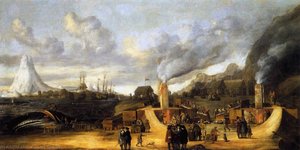
In the vast, sweeping expanse of Cornelis de Man’s The Whale-oil Factory on Jan Mayen Island, we are transported to a pivotal moment in maritime history. Painted in 1639, this monumental oil on canvas serves as more than just a landscape; it is a breathtaking narrative of human industry and the raw, untamed spirit of the North Atlantic. The scene unfolds with a remarkable sense of scale, capturing the bustling…


View in the Old Church in Delft from the choir towards portal.

Family portrait of Reyer Reyersz van der Burch (1630-95), Commissioners of the Ammunition at the Generality Magazines in Delft, with his wife Geertruid Graswinckel and their children Frank (b. 1658), Cornelis (b. 1660), Reyer (b. 1661), Maria (b. 1667) and Alida (b. 1670). On the left a table on which books and an ink set. To the right a look at the Tuighuis on the Geer in Delft.

Bu eserler arasında en sık temsil edilen ve her biri en bilinen örneğine sahip olan dört konu.
Bu sayfadaki tabloların çoğuna ev sahipliği yapan 5 müze.
| Müze | Şehir | Cornelis de Man Eserleri | Bu listedeki tablolar |
|---|---|---|---|
 Rijksmuseum |
Amsterdam | 4 | Pair Making Music, Cornelis de Man (manner of), 1650 - 1710, The Whale-oil Factory on Jan Mayen Island, Interior of the Oude Kerk in Delft from the Choir toward the Portal, Cornelis de Man (attributed to), 1660 - 1690 |
 Mauritshuis |
Lahey | 2 | Interior of the Laurenskerk in Rotterdam, Interior of the Laurenskerk, Rotterdam |
 Collection Six |
Amsterdam | 1 | A Man Weighing Gold |
 The Leiden Collection |
New York City | 1 | Portrait of the Pharmacist Dr. Ysbrand Ysbrandz. (1634/35–1705) in an interior |
 Szépművészeti Múzeum |
Budapeşte | 1 | The Chess Players |
Interior of the Laurenskerk in Rotterdam (1667), Mauritshuis, Lahey. Sonraki kayıtlar Pair Making Music, Cornelis de Man (manner of), 1650 - 1710 (1710) ve Interior of the Laurenskerk, Rotterdam (1664)'dir.
Interior of the Laurenskerk in Rotterdam, Pair Making Music, Cornelis de Man (manner of), 1650 - 1710, Interior of the Laurenskerk, Rotterdam, The Whale-oil Factory on Jan Mayen Island, A Man Weighing Gold, Interior with a Family and Two Nurses before a Fire, Portrait of the Pharmacist Dr. Ysbrand Ysbrandz. (1634/35–1705) in an interior, Interior of the Oude Kerk in Delft from the Choir toward the Portal, Cornelis de Man (attributed to), 1660 - 1690, Reyer Reyersz van der Burch (1630-1695), Ammunition Officer attached to the Arsenal of the States-General, Delft, with his Wife Geertruid Graswinckel and their Children Frank, Cornelis, Reyer, Maria and Alida, Cornelis de Man (attributed to), 1670 - 1680 ve Untitled (236). Yukarıdaki liste, her birinin tarihini ve bulunduğu müzeyi içermektedir.
Katalog, Cornelis de Man tarafından yapılmış 13 eseri içermektedir.
Esas olarak Rijksmuseum (Amsterdam), Mauritshuis (Lahey) ve Collection Six (Amsterdam) bünyesinde yer alır. Yukarıdaki müze tablosu tam dağılımı göstermektedir.
Bu sayfada listelenen 13 eser arasından People (2), Church interior (2) ve Portraiture (2)
Bu sayfada listelenen 13 eserden 4 tanesi Oil On Canvas türündedir.
Baroque, bu sayfadaki eserlerle belgelendiği üzere.
Pair Making Music, Cornelis de Man (manner of), 1650 - 1710, The Whale-oil Factory on Jan Mayen Island ve Interior of the Oude Kerk in Delft from the Choir toward the Portal, Cornelis de Man (attributed to), 1660 - 1690, Rijksmuseum, Amsterdam koleksiyonundaki bu sayfada yer alan 4 eser arasında bulunmaktadır.
In the vibrant tapestry of the Dutch Golden Age, few threads are as intricately woven as those left by Cornelis de Man. Born in the historic city of Haarlem around 1562, De Man emerged during a transformative era when the rigid structures of the late Renaissance were beginning to soften into the expressive fluidity of Northern Mannerism. As a pivotal figure of his time, he acted as a vital bridge between the classical ideals of the past and the burgeoning realism that would later define the works of masters like Frans Hals. His life and artistry represent a profound dialogue between the disciplined techniques of the Flemish tradition and a uniquely Dutch sensibility for capturing the soul within the subject.
The foundation of De Man’s extraordinary skill was laid through a rigorous and diverse apprenticeship. His early years in Haarlem were spent under the watchful eye of Pieter Pietersz, an artist whose mastery of landscape and portraiture provided De Man with a fundamental understanding of naturalism. However, it was his subsequent journey to Antwerp that truly expanded his artistic horizons. By studying under Gillis Coignet, De Man immersed himself in the sophisticated world of Flemish Mannerism. This period of intense training allowed him to absorb complex compositional structures and a refined approach to pigment handling, blending the architectural precision of the Southern Netherlands with the atmospheric depth characteristic of the Northern tradition.
To observe a work by Cornelis de Man is to witness a masterful manipulation of light, shadow, and texture. His style is defined by an exquisite balance between realism and mannerist elegance. While he drew inspiration from the idealized forms of the Italian Renaissance, De Man eschewed hollow perfection in favor of an unflinching honesty. He possessed a rare ability to capture the subtle nuances of human emotion—the slight furrow of a brow, the quiet intensity of a gaze, or the delicate tension in a hand—thereby imbuing his portraits and genre scenes with a profound psychological depth.
His technical repertoire was remarkably versatile, allowing him to navigate various thematic territories with ease:
The historical importance of Cornelis de Man lies not only in the beauty of his individual canvases but in his role as a precursor to the great Dutch masters of the 17th century. He helped cultivate an artistic language that prioritized the observation of nature and the emotional resonance of the human condition. His work served as a vital link in the evolution of Northern European art, moving away from the stylized distortions of late Mannerism toward the luminous realism of the Baroque period.
Though time has occasionally obscured the names of many artists from this era, De Man’s contribution remains etched in the development of the Haarlem School. His dedication to meticulous detail and his ability to harmonize vibrant color palettes with dramatic chiaroscuro ensured that his legacy would endure. Today, as we reflect on the transition from the Renaissance to the Golden Age, Cornelis de Man stands as a testament to the enduring power of an artist who could capture both the grandeur of the divine and the intimate truth of the human spirit.