


The Genesis of Impression: From Ancient Woodblocks to the European Renaissance
 The Enduring Legacy of Woodblock Printmaking: Technique, History & Artistic Expression
Origins & Evolution: From Ancient China to Global Art Form Wikipedia: Woodblock printing Woodblock printing or block printing is a technique for printing text, images or patterns used widely throughout East Asia and originating in China in antiquity ...
The story of printmaking is, at its heart, a tale of human ingenuity—a persistent, beautiful desire to replicate splendor and disseminate ideas beyond the limitations of a single hand-painted surface. Long before the digital age allowed for instantaneous reproduction, humanity sought ways to multiply images, sharing stories, beliefs, and artistic visions across vast distances. This journey did not begin with the grand masters of the Renaissance, but rather with the practical hands of ancient artisans. In the Han Dynasty of China, as early as the 5th century, woodblock printing flourished, initially serving the noble purpose of decorating textiles and later, most crucially, reproducing Buddhist scriptures. These early matrices, carved with meticulous care, demonstrated a sophisticated grasp of negative space and the profound power of repeated imagery.
As this knowledge traveled westward, it underwent a transformative evolution. By the 14th century, woodcut printing began to appear in Europe, primarily serving religious functions by providing devotional images to a populace that could not afford illuminated manuscripts. These early works, such as the Blockbücher, acted as vital stepping stones between the solitary beauty of hand-painted manuscripts and the era of mass communication. The true revolution, however, arrived with Johannes Gutenberg’s mid-15th-century development of movable type. While primarily a tool for text, Gutenberg’s press facilitated the integration of woodcut illustrations, marking a pivotal moment where word and image could be disseminated with unprecedented speed and accuracy, forever altering the cultural landscape of the West.
Intaglio Deciphered: The Technical Brilliance of Incised Lines
 Intaglio (printmaking)
Intaglio ( in-TAL-ee-oh, -TAH-lee-; Italian: [inˈtaʎʎo]) is the group of printing and printmaking techniques in which an image is incised into a surface and the incised line or sunken area holds the ink. It is the direct opposite of a relief print w...
To understand the true depth of printmaking, one must distinguish between the two great opposing forces of the craft: relief and intaglio. In the relief family—which includes woodcuts and linocuts—the artist works subtractively, removing material from around the desired image so that only the raised surface receives ink. It is a method of light and shadow defined by what remains. However, the advent of intaglio printing introduced a more complex, sophisticated dimension to the art form. Derived from the Italian word for "to incise," intaglio represents a complete reversal of the relief principle. Here, the image is not found on the surface, but within it.
In an intaglio process, the artist incises lines or sunken areas directly into a metal plate, typically copper or zinc. The printing ink is then rubbed into these recessed grooves and channels, while the surface of the plate is wiped clean. This requires immense pressure from a high-pressure press to force the dampened paper into the very incisions of the plate, literally pulling the ink out of the metal. This technique allows for a level of detail, tonal range, and delicate linework that relief printing simply cannot achieve. Whether through the corrosive bite of acid in etching or the physical strength of engraving, intaglio captures a sense of depth and texture that feels almost sculptural, inviting the viewer to trace the very path of the artist's hand.
The Burin’s Edge: Mastering the Tools and Precision of the Engraver
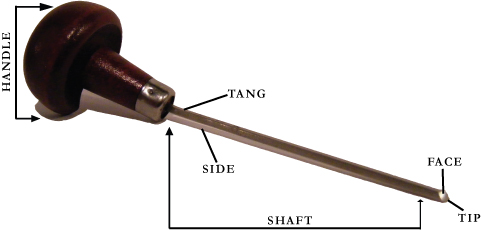 Burin (engraving)
A burin ( BUR(E)-in) is a steel cutting tool used in engraving, from the French burin (cold chisel). Its older English name and synonym is graver. == Etymology == The term burin refers to a tool used by engravers that has a thin, pointed blade and is...
At the center of this technical mastery lies the burin, a tool of singular purpose and formidable precision. Often referred to as a graver, the burin is a steel cutting tool with a sharp, V-shaped point, traditionally featuring a rounded, mushroom-shaped handle that fits into the palm of the engraver. To use a burin is to engage in a physical dialogue with metal; it requires a steady hand and an intimate understanding of resistance. As the artist pushes the blade through the copper, the tool carutches a clean, precise line, creating a groove that will later hold the lifeblood of the print: the ink.
The mastery of the burin is what separates the artisan from the master. An engraver must control the depth and width of each stroke to create the illusion of volume, light, and shadow. A shallow, light touch produces a delicate, silvery line, while deeper, more forceful incisions create bold, dark accents that anchor a composition. This level of control allows for the creation of intricate textures—the softness of skin, the heavy drape of velvet, or the cold glint of armor. It is this rigorous discipline that allowed Renaissance masters to translate the complexities of painting into the reproducible medium of print, ensuring that the fine details of their vision could be preserved through every subsequent impression.
Beyond the Surface: The Evolution from Relief Printing to Modern Intaglio
 n. krishna reddy
N. Krishna Reddy: A Life in Print n. krishna reddy (1925-2018) was an Indian master printmaker, sculptor, and teacher whose innovative approach to intaglio printing – particularly his pioneering use of viscosity printing – revolutionized the field an...
As art history progressed, the boundaries of printmaking continued to expand through constant experimentation. While engraving and etching remained dominant for centuries, new techniques emerged to push the limits of tonal expression. We see this evolution in the development of drypoint, where the artist scratches directly into the plate without acid, leaving a "burr" that catches extra ink to create a soft, velvety blur. We see it in aquatint, which allows for the creation of broad, wash-like areas of tone, and mezzotint, a technique that builds light out of darkness by roughening the entire plate before smoothing it back to highlights.
This spirit of innovation was not confined to the past. In the 20th century, masters like N. Krishna Reddy revolutionized the field through viscosity printing, an advanced intaglio method that allowed for vibrant, multi-colored abstract compositions. This progression shows that printmaking is never a static medium; it is a living, breathing discipline. From the functional textile prints of ancient China to the complex, multi-layered experimental works of the modern era, the evolution of printmaking reflects the broader history of human creativity—a constant movement toward greater complexity, deeper emotion, and more profound ways to capture the ephemeral beauty of our world.
The Enduring Legacy: How Printmaking Shaped the Visual Language of History
 The Enduring Legacy of Printmaking: Techniques, Themes & Artistic Innovation Across Centuries
The Genesis of Printmaking: From Ancient Origins to Early European Developments Wikipedia: Printmaking Printmaking is the process of creating artworks by printing, normally on paper, but also on fabric, wood, metal, and other surfaces. "Traditional p...
The legacy of engraving and printmaking is woven into the very fabric of our visual culture. It democratized art, allowing the masterpieces of the great painters to travel far beyond the walls of cathedrals and palaces, reaching the hands of scholars, students, and common citizens alike. This dissemination of imagery fostered a shared visual language across continents, influencing everything from the fine arts to the design of modern typography and even the way we perceive mass media today.
At WikiOO.org, we hold a profound reverence for this history of craftsmanship. While we specialize in the breathtaking beauty of hand-painted oil reproductions—capturing the thick impasto and luminous glazes of the masters on 100% cotton canvas—we recognize that the precision of the engraver's line is what laid the foundation for all visual storytelling. Whether you are seeking a museum-quality reproduction of a Renaissance masterpiece or a custom portrait that reimagines your own history through the lens of a classical style, we invite you to celebrate the enduring power of the artist's hand. We invite you to bring the weight of history into your own space, preserving the artistry of the past for generations to come.


