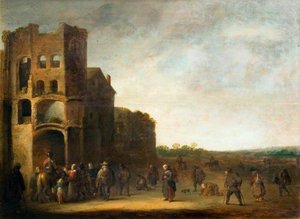
Pieter de Bloot: A Dutch Landscape Painter Capturing Rural Tranquility
Pieter de Bloot (1601 – c. 6 November 1658) stands as a significant, yet often overlooked, figure within the Dutch Golden Age artistic landscape. Born in Rotterdam, he emerged from a family steeped in artistic tradition—his father, Jan van Asch, was himself a respected portrait painter—establishing him firmly within the vibrant Delft art scene and shaping his stylistic inclinations. While overshadowed by contemporaries like Rembrandt and Vermeer, de Bloot’s contribution to genre painting, particularly landscapes imbued with atmospheric perspective and detailed depictions of rural life, deserves renewed appreciation.- Early Life & Training: De Bloot's formative years were spent honing his skills under the tutelage of his father, absorbing the principles of classical portraiture and mastering techniques crucial for conveying emotion and realism. This grounding in traditional painting would profoundly influence his later artistic endeavors.
- Marriage & Family: His life was marked by several marriages—first to Maria van der Linde, followed by Elisabeth van Nieuwenhuijzen, and lastly to Anna Catharina van Voorbergen—a testament to the social conventions of his time. Tragically, two of his wives succumbed to illness shortly after their nuptials, leaving him with a poignant reminder of life’s fragility.
De Bloot's Artistic Style & Influences
De Bloot’s artistic style is characterized by a meticulous attention to detail and an unwavering commitment to capturing the essence of his subjects. Unlike many artists of his era who favored grand narratives or idealized figures, de Bloot focused primarily on landscapes—often serene countryside vistas—and genre scenes depicting everyday peasant life. His canvases resonate with a palpable sense of realism, achieved through masterful use of chiaroscuro – dramatic contrasts between light and shadow – mirroring the techniques championed by Caravaggio and influencing his compositional choices. The artist’s penchant for atmospheric perspective, evident in works like “A Ferry Boat on a Calm Sea,” demonstrates an understanding of scientific principles aimed at conveying depth and spatial illusion.Notable Works & Achievements
Among de Bloot's celebrated paintings are "The Lawyer’s Office," showcasing a meticulously rendered interior scene reflecting the social realities of his time, and “Saint Martin and the Beggar,” which exemplifies Baroque artistic sensibilities with its emotive portrayal of religious devotion. His commissions included monumental scheemakers or overmantels for prominent Delft civic buildings—most notably the Prinsenhof City Hall—solidifying his reputation as a respected artist within the city’s cultural elite. Furthermore, he collaborated with Pieter Jansz van Asch on a mezzotint portrait, demonstrating an appreciation for printmaking alongside painting.Historical Significance & Legacy
Pieter de Bloot's oeuvre represents a crucial facet of Dutch artistic heritage—a celebration of the pastoral beauty and humble dignity of rural existence. While his output may not rival that of Rembrandt or Vermeer in terms of fame, his paintings continue to captivate viewers with their evocative atmosphere and unwavering fidelity to observation. His work serves as an invaluable window into the social and intellectual currents of the seventeenth century, reminding us that artistic excellence can flourish across diverse stylistic approaches—a testament to the enduring power of landscape painting and its ability to convey profound human emotion.Otázky a odpovědi
Jak najdu všechna díla umělce Pieter de Bloot v určitém médiu?
Stránka Podle techniky seskupuje díla umělce Pieter de Bloot podle použité techniky.
V jakém městě a z jaké země pochází Pieter de Bloot?
Pieter de Bloot se narodil(a) ve městě Rotterdam v zemi Netherlands.
V jakém historickém období působil/a Pieter de Bloot?
Pieter de Bloot působil v období Early Modern. Toto období historicky vymezuje uměleckou činnost tohoto autora.