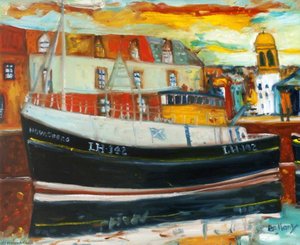


1


Ενημερωμένο Οκτώβριος 2026 · κατάταξη βάσει του σκορ δημοφιλίας μας (αναζητήσεις, επισκέψεις και παραγγελίες για κάθε έργο) · 50 έργα του John Bellany στον κατάλογό μας
Σύνοψη
Το πιο γνωστό έργο του John Bellany είναι το 'Nova Spero'. Οι επόμενες εγγραφές είναι οι Top Hat Masquerade (1991) και Two Girls by Harbour (2006). Ο κατάλογος περιλαμβάνει 50 έργα του John Bellany· τα 50 στοιχεία παρακάτω είναι τα πιο γνωστά, ταξινομημένα κατά σειρά κατάταξης με ημερομηνία, το μουσείο που τα διαθέτει και περιγραφή.


 Camden Lock1990
12
 Scottish Gothic1990
13
 Sir Peter Maxwell Davies (b.1934), Composer1991
14
 Sweet Promise (triptych, right wing)1994
15
 Fishing Boat 'Poseidon' in Harbour1994
16
 Sweet Promise (triptych, centre panel)1994
17
 The Old Sailor Dreams of His Past1994 · Jerwood Gallery
18
 Girl with Yellow Background1998 · Βασιλική Ακαδημία Τέχνης και Σχεδιασμού
19
 Anchored1999
20
 Summer Flowers1999 · The Ingram Collection of Modern British And Contemporary Art
21
 Ships in Harbour2000 · The Ingram Collection of Modern British And Contemporary Art
22
 Homage to David B2002
23
 Scottish Mother and Child2005
24
 Old Woman1991
25
 God is Love
26
 'The Hope'
27
 'The Scarlet Lord'
28
 The Old Man and the Sea
29
 The Obsession
30
 Self PortraitThe Fleming Collection
31
 Girl with Fish
32
 Harbour Scene (detail)The Scottish Government
33
 Fishing BoatThe Scottish Government
34
 Idyllic Childhood Memories (triptych, left panel)Preston Lodge High School
35
 'EH12'
36
 Woman with Fish on HeadEdinburgh College of Art
37
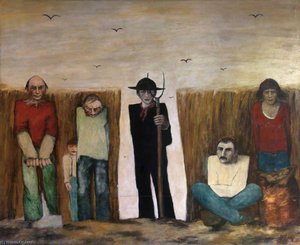 The HarvesterBrunton Hall
38
 Lovers by the Sea
39
 Idyllic Childhood Memories (triptych, right panel)Preston Lodge High School
40
 Fishing Trawler
41
 Sunrise, NudeHeriot-watt University
42
 Harbour Scene with BoatsJohn Muir House
43
 Love Song Homage to TitianΜουσείο Φιτσίουελλ
44
 The Severed HeadMiddlesbrough Institute of Modern Art
45
 Woman with a LobsterGuildhall Art Gallery
46
 Professor Sir John Lyons, LittD, FBA, Master (1985–2000)Trinity Hall
47
 FloraTrinity Hall
48
 Idyllic Childhood Memories (triptych, centre panel)Preston Lodge High School
49
 Untitled1999
50
 The Loyal Friend
Τα τέσσερα θέματα που αναπαρίστανται πιο συχνά σε αυτά τα έργα, το καθένα με το πιο γνωστό του παράδειγμα.
Τα 8 μουσεία που φιλοξενούν το μεγαλύτερο μέρος των έργων σε αυτήν τη σελίδα.
| Μουσεία | Πόλη | Έργα του John Bellany | Πάτρια από αυτή τη λίστα |
|---|---|---|---|
 Preston Lodge High School |
Prestonpans | 3 | Idyllic Childhood Memories (triptych, left panel), Idyllic Childhood Memories (triptych, right panel), Idyllic Childhood Memories (triptych, centre panel) |
 Edinburgh College of Art |
Εδιμβούργο | 2 | Two Girls by Harbour, Woman with Fish on Head |
 The Fleming Collection |
London | 2 | The Ettrick Shepherd, Self Portrait |
 Μουσείο Φιτσίουελλ |
Κέμπριτζ | 2 | Sarah with Aga, Love Song Homage to Titian |
 The Ingram Collection of Modern British And Contemporary Art |
London | 2 | Summer Flowers, Ships in Harbour |
 The Scottish Government |
Edinburgh | 2 | Harbour Scene (detail), Fishing Boat |
 Trinity Hall |
Κέιμπριτζ | 2 | Professor Sir John Lyons, LittD, FBA, Master (1985–2000), Flora |
 Μετροπολιτικό Μουσείο Τέχνης |
Νέα Υόρκη | 1 | The Screeching Gannett |
Επιλέξτε μια δεκαετία για να εμφανιστεί το κύριο έργο της.
'Nova Spero'. Οι ακόλουθες εγγραφές είναι Top Hat Masquerade (1991) και Two Girls by Harbour (2006).
'Nova Spero', Top Hat Masquerade, Two Girls by Harbour, The Ettrick Shepherd, Portrait of Julie, Living Flowers, Sad Monkey Loses His Heart, The Fisherman, The Screeching Gannett και Sarah with Aga. Η παραπάνω λίστα καταγράφει την ημερομηνία και το μουσείο που τα φυλάσσει.
Ο κατάλογος περιλαμβάνει 50 έργα του John Bellany, με ημερομηνίες από 1966 έως 2006.
Κυρίως σε Preston Lodge High School (Prestonpans), Edinburgh College of Art (Εδιμβούργο) και The Fleming Collection (London). Ο πίνακας μουσείων παραπάνω δείχνει την πλήρη κατανομή.
Στην 1990s: 14 από τα 50 έργα που περιλαμβάνονται σε αυτήν τη σελίδα χρονολογούνται σε αυτήν την περίοδο, συμπεριλαμβανομένου του Top Hat Masquerade.
Το παλαιότερο έργο που περιλαμβάνεται εδώ είναι του The Fisherman (1966), ενώ το νεότερο είναι του Two Girls by Harbour (2006).
Dark narrative (4), Scottish art (4) και Symbolic imagery (3), από τα 50 έργα που περιλαμβάνονται σε αυτήν τη σελίδα.
Expressionism και Contemporary realism, όπως τεκμηριεύονται από τα έργα σε αυτήν τη σελίδα.
Τα Idyllic Childhood Memories (triptych, left panel), Idyllic Childhood Memories (triptych, right panel) και Idyllic Childhood Memories (triptych, centre panel) περιλαμβάνονται στα 3 έργα σε αυτήν τη σελίδα από τη συλλογή του Preston Lodge High School, Prestonpans.
Born in 1942 amidst the salt-sprayed fishing traditions of Port Seton, near Edinburgh, John Bellany CBE, RA emerged as one of Scotland’s most profound and evocative visual storytellers. His identity was inextricably linked to the rhythms of the Firth of Forth; as the grandson and son of fishermen, the sea was not merely a landscape to him, but a living, breathing character that permeated his entire creative consciousness. This deep-rooted connection to the maritime world provided the foundational vocabulary for an oeuvre that would later masterfully blend the visceral realities of coastal life with a haunting, surrealist symbolism.
Bellany’s artistic journey was shaped by rigorous academic exploration and a transformative encounter with European modernism. During his formative years at the Edinburgh College of Art, he forged lasting bonds with contemporaries such as Alan Bold and Alexander Moffat, contributing to a movement dedicated to revitalizing Scottish art through a blend of local heritage and international influence. A pivotal moment in his development occurred during his travels to Europe, where the monumental war triptychs of Otto Dix in Dresden left an indelible mark on his psyche. This exposure to German Expressionism encouraged Bellany to confront the darker, more difficult truths of the human condition, teaching him how to utilize distorted forms and heavy textures to articulate themes of guilt, mortality, and original sin.
The brilliance of Bellany’s work lies in his ability to weave personal mythology into the fabric of his paintings. His compositions are often vast and complex, acting as dreamscapes where the boundaries between the natural world and the psychological realm dissolve. In his earlier works from the 1960s and 1970s, one finds a preoccupation with the darker aspects of existence—sex, death, and the inherent flaws of humanity. He utilized a rich, symbolic language derived from both his maritime upbringing and religious iconography, often populating his canvases with motifs such as:
As his life progressed, particularly following a significant health battle and a liver transplant in 1988, a palpable shift occurred within his palette and temperament. The heavy, brooding shadows of his youth began to give way to a more luminous, optimistic energy. While the visceral textures of impasto and the expressive realism of his technique remained, the narrative arc of his work moved toward a celebration of life and resilience, proving that even within the most turbulent seas, light can find its way through.
John Bellany’s contribution to British art history is marked by his ability to elevate regional Scottish identity to a universal stage. His election to the Royal Academy in 1973 served as a formal recognition of his mastery and his role in shaping the trajectory of modern Scottish painting. Through his teaching career and his prolific output, he mentored generations and expanded the boundaries of what contemporary figurative art could achieve.
Today, his legacy is preserved in the permanent collections of prestigious institutions such as the Tate and the National Galleries of Scotland. He remains a titan of 20th-century art, remembered not just for his technical prowess or his mastery of watercolor and oil, but for his courage to look into the depths of the human soul and find the profound beauty hidden within the struggle. His work continues to resonate as a powerful testament to the enduring connection between the land, the sea, and the indomitable spirit of man.

