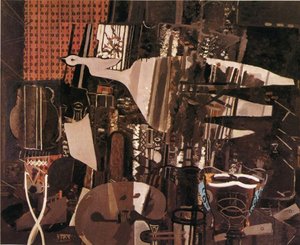
- 112.0 x 146.0 cm


 Esikatselu
 Jaa teos
 Jaa
Jaa
 Tiedot
 Opas
Opas

 Lataa kuva
 Samanlaisia kohteita
 Röntgenkuvaus
 Diaesitys
 Q&A
Q&A Tilastot
Look closer
Every detail, painted by hand
Max Ernst's "Day and Night" is a surrealist masterpiece blending multiple images & sculptures into a dreamlike composition. Explore the layers of symbolism and artistic innovation within this iconic 1941 painting.
i.
The heart of the scene.
ii.
Light and background.
iii.
The brushwork.
The painting
The Enigmatic Landscape of Dreams: Unpacking “Day and Night”
Max Ernst’s “Day and Night,” painted in 1941, isn't merely a depiction of opposing forces; it’s an immersive descent into the subconscious. This oil-on-canvas work, measuring a substantial 112 x 146 cm, immediately captivates with its layered complexity – a deliberate orchestration of fragmented images, embedded paintings, and scattered sculptures that defy easy interpretation. Ernst, a pivotal figure in both Dada and Surrealism, masterfully employs his signature technique to challenge the viewer’s perception, inviting us into a world where logic dissolves and dreams take precedence. The painting isn't about representing reality; it’s about evoking a feeling – a potent blend of mystery, disorientation, and profound psychological depth.
The initial impact is one of controlled chaos. Rectangular frames, reminiscent of picture windows or portals, dominate the composition, each containing miniature scenes that seem to bleed into one another. These aren’t static snapshots; they're glimpses of fleeting moments, distorted landscapes, and abstract textures. The deliberate use of repetition – the recurring presence of these framed images – creates a hypnotic effect, drawing the eye deeper into the painting’s intricate web. Notice how some frames seem to be looking out at us, while others are lost within their own contained worlds, suggesting an exploration of both introspection and external observation.
Surrealist Techniques: A Symphony of Disparate Elements
Ernst's genius lies in his ability to seamlessly blend seemingly incompatible elements. “Day and Night” is a prime example of his mastery of Surrealist techniques, particularly the incorporation of frottage – a method he pioneered involving rubbing textured materials onto paper to create random patterns – and decalcomania, where paint is transferred from one surface to another under pressure. These processes deliberately introduce chance and spontaneity into the creative process, liberating the artist from conscious control and allowing subconscious associations to emerge. The inclusion of sculptures further amplifies this effect; they aren’t simply decorative additions but integral components of the painting's narrative, adding a tactile dimension to the visual experience.
Consider the interplay of light and shadow within the framed images. Some scenes are bathed in an almost ethereal glow, suggesting twilight or dawn, while others are shrouded in darkness, hinting at the mysteries of night. This duality is not merely aesthetic; it reflects Ernst’s broader exploration of opposing forces – day versus night, consciousness versus unconsciousness, order versus chaos. The careful manipulation of color—primarily dark blues and browns punctuated by flashes of vibrant hues within the framed images—contributes significantly to this evocative atmosphere.
Historical Context & Symbolic Resonance
“Day and Night” was created during a period of immense social and artistic upheaval – the early 1940s, amidst the turmoil of World War II. Surrealism, as a movement, offered an escape from the horrors of reality by delving into the realm of dreams and the subconscious. Ernst’s work aligns perfectly with this ethos, providing a visual language for exploring anxieties, fears, and desires that lie beneath the surface of everyday life. The inclusion of embedded paintings within the larger composition can be interpreted as a commentary on art itself – questioning its ability to accurately represent reality or offering alternative pathways to understanding.
Furthermore, the painting’s symbolism is rich and layered. The scattered sculptures could represent fragments of memory, lost identities, or the remnants of shattered dreams. The overall composition suggests a journey through an internal landscape—a quest for meaning in a world seemingly devoid of order. It's a testament to Ernst's ability to distill complex psychological themes into a single, powerfully evocative image.
Bringing “Day and Night” Home: A Reproduction Worth Cherishing
WikiOO offers meticulously crafted hand-painted reproductions of Max Ernst’s “Day and Night,” allowing you to bring this extraordinary artwork into your own space. Our skilled artists replicate Ernst's intricate techniques with the utmost care, ensuring that every detail—from the subtle textures to the nuanced color palette—is faithfully reproduced. Whether adorning a gallery wall or serving as a focal point in a living room, this reproduction will serve as a constant source of contemplation and inspiration. Explore our high-resolution images and select the size and canvas material that best suits your vision. Discover more about “Day and Night” on WikiOO.
Kysymykset ja vastaukset
Onko Max Ernst:n "Day and Night" yksi kysytyimmistä Surrealism -tyylin teoksista?
Max Ernst:n "Day and Night" on luokiteltu Iconic ja se kuuluu Surrealism-tyylisuuntaan.
Ovatko teoksen "Day and Night" värit voimakkaita vai hillittyjä?
Max Ernst:n "Day and Night"-teoksen värit ilmentävät Balanced Soft kylläisyyttä ja Monochromatic voimakkuutta.
Mistä voin löytää tilastoja teoksesta Max Ernst:n "Day and Night"?
Teokselle "Day and Night" on olemassa Tilastot -sivu. Se esittää teoksen ja taiteilijan muiden teosten kuukausittaiset vierailumäärät maakohtaisesti ja kielittäin eriteltynä.
Tämä teos on tekijänoikeuden suojaama
Tällä sivulla esitettyä taideteosta suojaa tekijänoikeuslaki, mikä tarkoittaa, ettemme voi laillisesti luoda tai myydä täsmälleen samanlaista jäljennöstä. Tämä suoja toteutetaan kansainvälisten sopimusten, kuten esimerkiksi Berne-konventio ja kansallisilla laeilla, mukaan lukien niillä määritellyt Yhdysvaltain tekijänoikeuslaki – Luku 17. Kaikki oikeudet pidätetään. Luvaton kopiointi tai jäljittely on kielletty.
Kunnioittavana ja laillisena vaihtoehtona tarjoamme alkuperäisestä inspiroituneita, yksilöllisiä ja käsinmaalattuja taideteoksia. Taitavat ja ammattimaiset taiteilijamme tutkivat huolellisesti alkuperäisen teoksen tyyliä, tunnelmaa ja taiteellista ydintä luodakseen uuden, ainutlaatuisen teoksen, joka herättää saman tunteen – säilyttäen samalla oman itsenäisen alkuperäisyytensä.
Tämä menetelmä noudattaa täysin tekijänoikeussäännöksiä, sillä se ei sisällä suojatun taideteoksen kopioimista tai jäljentämistä. Sen sijaan kyseessä on luova uudelleentulkinta – uusi maalaus, joka ammentaa vaikutteita alkuperäisestä, mutta ei ole sen identtinen kopio.
 Lue lisää
Max Ernst
1891 - 1976, Saksa
The painter
Tutustu Max Ernstin (1891-1976) surrealistiseen maailmaan! Uppoudu hänen innovatiivisiin tekniikoihinsa, unelmaisiin maalauksiinsa ja symboliikkaan. #MaxErnst #Surrealismi #Dada
Taiteilijan elämäkerta
A Life Immersed in the Surreal
Max Ernst, syntynyt Maximilian Maria Ernst nimellä 1. huhtikuuta 1891 Brühlissä Saksassa, oli levoton henki, jonka kohtalona oli tulla yhdeksi 20-luvun taiteen keskeisimmistä hahmoista. Hänen matkansa ei ollut perinteisen taideopintojen reittiä; se oli itseohjattu tutkimus, joka perustui filosofiseen pohdintaan, psykologiseen kiinnostukseen ja syvään epäuskoon yhteiskunnan normeihin. Ernstin isä, kuurojen opettaja ja harrastemaalari, sisällytti häneen sekä maailmanherkäyden että kapinallisen asenteen perinteisiä auktoriteetteja vastaan. Tämä varhainen kaksoisluonne muotosi taiteellisen vision keskeiseksi piirteeksi.
Ernstin akateemiset opinnot Bonnissa – filosofian, taidehistorian, kirjallisuuden, psykologian ja psychanterian saralla – eivät olleet pelkästään sivuharrastuksia vaan perusrakenteita, jotka syvästi vaikuttivat myöhempiin töihin. Hän ei ollut kiinnostunut vain *miten* maalata; hän pohdiskelee *miksi*. Tämä älyllinen uteliaisuus johti hänet kohtaamaan modernismin mullistavia teoksia Picasson, Van Goghin ja Gauguin’n kautta Sonderbund-näyttelyssä Kööpenhaminassa vuonna 1912 – hetki, joka muutti hänen taiteellista polkuaan peruuttamattomasti. Modernismin siemenet olivat kylvetty.
Dada’n Häiriöt ja Surrealististen Visioiden Synty
Ensimmäisen maailmansodan kauhistus osoittautui Ernstin elämässä merkittäväksi hetkeksi. Sodan kokemukset sekä Itä- että Länsirintamalla jättivät hänet syvästi järkyttyneeksi, mikä johti syvään epäluottamukseen perinteisiin järjestyksiin ja kaipuuseen uusiin ilmaisumuotoihin. Tämä pettymys löysi kasvualustan kehittyvälle Dada-liikkeelle, johon hän omaksui innokkaasti palatessaan Kööpenhakiin vuonna 1918. Hans Arpin – ikuisen ystävänsä ja kollegoitsensä kanssa – Ernstista tuli keskeinen hahmo Kööpenhaminan Dada-ryhmässä, hyläten perinteiset taiteelliset konventiot ja omaksuttaen absurdiutta, sattumanvaraisuutta ja rationaalisuuden vastustusta.
Dada oli kuitenkin vain välietappi. 1920-luvun alussa Ernst muutti Pariisiin ja liittyi Surrealistisen ryhmän pariin, jonka johti André Breton. Tässä yhteydessä hän tutki unelmien, alitajunnan ja irrationaalisuuden maailmoja. Vaikka hänet inspiroivat Sigmund Freudin psykologian teoriat, Ernst pyrki avaamaan ihmisen syvimpiä kerroksia taiteensa kautta. Hän ei ollut kiinnostunut kuvailemaan todellisuutta sellaisena kuin se näkyy, vaan paljastamaan sen alla olevat psykologiset voimat, jotka muokkaavat sitä.
Innovatiivisten Tekniikoiden Kehittäminen: Frottage, Grattage ja Collage
Ernstin taiteellinen innovaatio ulottui myös aiheen ylitse; hän oli loputon kokeilija tekniikoissa. Hän ei vain ottanut olemassa olevia menetelmiä – hän keksi uusia. Hänen tunnetuin panoksistaan on frottage, prosessi, jossa lyödään piirustuspenseliä tai hiiliä teksturoituun pintaan luodakseen odottamattomia ja herättävän näköisiä kuvioita. Tämä tekniikka, joka syntyi hetken tylsyyden seurauksena puunpuun kuviota tarkastellessa, mahdollisti Ernstin pääsyn alitajuntaan ja muodollisten elementtien luomisen, jotka haastoivat tietoisen kontrollin.
Lähellä tätä oli grattage, jossa maali raaputaan pois kankaalta paljastaen alla olevat kerrokset. Hän myös hallitsi mestarillisesti collagea, kokoamalla erilaisia elementtejä – kuvia lehdistä, tieteellisiä kuvituksia, valokuvia – surrealistisiin kokoonpanoihin, jotka kyseenalaistivat perinteiset esitystavat. Nämä tekniikat eivät olleet pelkästään tyylivalintoja; ne olivat keskeisiä hänen tutkimuksessaan alitajunnan ja hänen pyrkimyksensä haastaa taiteelliset rajat suhteen.
Vaikutukset ja Perintö
Toisen maailmansodan puhkeaminen pakotti Ernstin pakenemaan Eurooppaa, löytäen turvapaikan Yhdysvalloista. Hän jatkoi taiteilijan työtään ja kokeili uusia tekniikoita eksiliössä, palaten lopulta Ranskaan sodan jälkeen, jossa hän pysyi aktiivisena kuolemaansa asti 1. huhtikuuta vuonna 1976.
Ernstin panokset Dadaan ja Surrealismiin olivat peruuttamattomia. Hän haastoi taiteelliset normit, sukelsi ihmisen alitajunnan syvyyksiin ja keksi innovatiivisia tekniikoita, jotka inspiroivat edelleen taiteilijoita tänäkin päivänä. Hän ei ollut pelkästään maalari; hän oli tutkija, provokaattori ja visioiva henkilö, joka laajensi taiteen rajat itsensä.
- Merkittävät teokset: The Entire City, Euclides, Ofrenda funeraria, Forest and Dove
- Vaikuttajat: Pablo Picasso, Vincent van Gogh, Paul Gauguin, Sigmund Freud, Giorgio de Chirico
- Liikkeet: Dada, Surrealismi
Quick facts about Max Ernst
- Artistic Movement Or Style: Dada ja Surrealismi
- Artists Or Movements Influenced By This Artist:
- Surrealismi
- Dada
- Artists Who Influenced This Artist:
- Picasso
- Van Gogh
- Gauguin
- Date Of Birth: 1.4.1891
- Date Of Death: 1.4.1976
- Full Name: Max Ernst
- Nationality: Saksalainen/Amerikkalainen
- Notable Artworks:
- Kaupunkikuva
- Nainen
- Lintu ja päivä
- Place Of Birth: Brühl, Saksa


Käsinmaalattu öljyvärinen jäljennös
Have it painted for you
Käsinmaalattu öljyvärinen jäljennös
Käsinmaalattu öljyväri kankaalle haluamassasi koossa ja kehyksissä, taiteilijoidemme valmistamana tilauksesta. ( Vaihda tulosteeseen Siirry digitaaliseen kuvaan)

Your commission

Day and Night
Reproduktiotekniikka
Replikaatin koko
-

Kokenut huipputaiteilija
Lisää yksityiskohtia, hienostuneisuutta ja enemmän aikaa tuotantoon
-

Reproduktion kehystysvaihtoehdot
-
-
Teoksille tai reproduktioille, joiden mikä tahansa sivu on suurempi kuin 105 cm (noin 41 tuumaa), kehys toimitetaan osina purettuna sarjana. Tämä menetelmä varmistaa turvallisen toimituksen ja ehkäisee vaurioita kuljetuksen aikana.
Vaatii ammattimaista kokoamista – kyseessä ei ole tee-se-itse-tuote.
Sarja on koottava ja kangas kiristettävä kokeneen kehystysammattilaisen toimesta käyttäen puuliimaa (ei sisälly pakkaukseen), kangaspinnetteitä ja puristimia, jotta kehyksen kulmat pysyvät suorina liiman kuivuessa. Virheellinen kokoaminen tai epätasainen kankaan kiristys voi vaurioittaa teosta pysyvästi, eikä tällaiset vauriot ala takuun piiriin.
 Teoksille tai reproduktioille, joiden mikä tahansa sivu on suurempi kuin 105 cm (noin 41 tuumaa), kehys toimitetaan osina purettuna sarjana. Tämä menetelmä varmistaa turvallisen toimituksen ja ehkäisee vaurioita kuljetuksen aikana.
Kaikki massiivipuupalat sisältyvät, tarkasti mittojen mukaan leikattuina.
Kootaan mukana tulevilla ruuveilla sekä kulmaliitoksia varten tarvittavalla puuliimalla, jota ei toimiteta, joten se on hankittava kehystäjältä.
Vaatii ammattilaisvälineitä, jotka eivät sisälly pakkaukseen: kankaan venytyspihdit (kiristin) ja puristimet, joilla pidetään kehyksen puut suorassa liiman kuivuessa.
Tärkeää:
Kulmaliitoksissa tarvitaan puuliimaa, kehyksien osat on pidettävä puristimilla, kunnes liima on täysin kuivunut, ja koottuun kehykseen jännitettävän kankaan kiristämiseen tarvitaan kangaspenssipihti. Mikään näistä ei sisälly pakkaukseen. Suosittelemme varmistamaan kokeneen kehystäjän saatavuuden ennen tämän kokoisen kehyksen tilaamista.

Nimilaatta
-
-

Suojalakkaus
Kiiltävä lakka (syventää värejä, suojaa valolta ja kosteudelta)
-

Mukauta taideteokseni
Esimerkkejä muokattavista asioista: Vaihda kasvot asiakkaan omaan valokuvaan; Lisää lemmikki (esim. vaihda kissa koiraan); Lisää taustalle piilotettu viesti; Muuta taustan maisemaa tai elementtejä.
-

Pikatoimitus
Maailmanlaajuinen toimitus () 3–4 viikossa tavallisen 5 viikon sijaan. (3 marraskuu). Laadusta ei tingitä.
-
Pikatoimitus
Maailmanlaajuinen toimitus () 5 viikon kuluessa. (10 marraskuu).
Sisältyy hintaan
Kokonaishinta
€ 236
Lasivaihtoehto on saatavilla vain alle 110 cm kokoisille teoksille
i.
Scale
The original measures 112.0 x 146.0 cm. Slide to your wall: every size keeps its proportions.
Valitse valmiista mitoistamme sellaiset, jotka vastaavat teoksen alkuperäisiä mittasuhteita.

Kirjoita tarvitsemasi leveys ja korkeus, jotta teos sopii kehyksiisi tai seinällesi. Koska kyseessä on käsinmaalattu teos, taiteilija voi maalata hieman enemmän kuvan ympärille tai rajata sitä hieman, jos haluat eri muotoisen koon — valinta on sinun. Lähetämme sinulle digitaalisen mallikuvan hyväksyttäväksi ennen kuin maalaus alkaa. Tällä sivulla näkyvä kuva ei vastaa lopullista tulosta — vain mallikuva näyttää sen.
ii.
Frame
The frame is drawn on the painting at its true width.
Kehystetty

White €1

Blurside €1

Extended €1

P118B €10

P118H €10

P118W €10

P438Z €10

P508JH €12

P508YH €12

P805H €10

P805Z €10

P919BZ €10

P919G €10

P919XJ €10

P959ZH €10

P968JZ €12

W106C €8

W218G €10

W218JH €8

W218Y €10

W307PJ €10

W316G €10

W316PJ €8

W316Y €10

W398PJ €8

W4111J €10

W500HY €15

W500JH €15

W692G €12

W849H €8

W940BG €15

W953PJ €8

H24-GOLD €30

H24-SILVER €30

H36-GOLD €45

H36-SILVER €45
iii.
Make it yours
A painting made by hand can be made for one person.
iv.
Finishing
Nameplate, varnish and delivery.
Nimilaatta
Kaiverretun pronssilaatan tiedot
This elegant plaque features the artist's name and the title of the artwork, finely engraved for a timeless presentation.
It is made from bronze with a refined, elegant finish. The text is precisely laser-engraved for a sharp and permanent result. Measuring 9x2 cm, the plaque is compact yet easy to read. It's built to be durable and scratch-resistant, offering a professional, museum-quality look. Mounting is simple thanks to the included adhesive backing.
Läpinäkyvän akryylilaatan tiedot
The plaque includes essential engraved details such as the artist's name, the title of the artwork, the date it was created, the type of media used-like oil on canvas or watercolor-a brief description of the piece, and a QR code that links to the complete artwork information.
It is crafted from clear acrylic, offering a sleek, modern appearance. The text is UV-engraved in black to ensure strong visual contrast. With a size of 10x15 cm, it ensures optimal readability. It comes equipped with two metal hooks for secure wall mounting. The plaque is designed to be weather-resistant, making it suitable for various environments, and it includes interactive features that work seamlessly with smartphone scanning.
Mustan akryylilaatan tiedot
This elegant plaque includes engraved information such as the artist's name, the title of the artwork, the date it was created, the type of media used (like oil on canvas or watercolor), a short description of the artwork, and a QR code for quick access to more information.
The plaque itself is made from refined black acrylic with a premium finish. The text is laser-engraved in white for high contrast and readability. Its size is 10x15 cm, designed to be easy to read. It comes with two metal hooks for professional mounting. The design is sleek and fits any interior style. It is also weather-resistant and durable, with built-in digital integration for mobile compatibility.
Suojalakkaus
Pikatuotanto ja -toimitus
Maailmanlaajuinen toimitus () 3–4 viikossa tavallisen 5 viikon sijaan. (3 marraskuu). Laadusta ei tingitä.
- Ilmainen pikatoimitus ympäri maailman
- Korkealaatuinen pellavakangas
- Kattava kuljetusvakuutus
- Tulliveron palautustakuu
- Takuu täydellisestä värien vastaavuudesta
- 100 päivän palautusoikeus (vain valmistusvirheet)
- 100% rahat takaisin -takuu
- Määräalennus tarjolla


Quick facts and art quiz
Aiheeseen liittyvät artikkelit

The Enduring Legacy of Oil on Canvas: Technique, History & Aesthetic Impact
Explore the rich history & techniques of oil painting – from Renaissance masters to Impressionism. Discover pigments, layering methods, and why this timeless medium endures. Expert insights for artists & art enthusiasts.

Oil on Canvas: A Historical & Technical Exploration of a Timeless Artistic Medium
Explore the rich history & enduring techniques of oil painting on canvas. Discover the science behind its longevity, conservation practices, and contemporary relevance. Expert insights for art enthusiasts.

The Enduring Power of Painting: A Historical & Contemporary Exploration of Form and Emotion
Explore the rich history & enduring techniques of oil painting with WikiOO. Discover masterpieces, learn about art collecting, and find authentic handmade reproductions crafted by skilled artists.
Max Ernstin 25 mestariteosta: Surrealismin syvyydet ja taidekodin inspiraatio
Tutustu Max Ernstin 25 vaikuttavimpaan mestariteokseen! Uppoudu surrealismin maailmaan, dadaismin juuriin ja taiteilijan psykologisiin visioihin. Löydä inspiraatiota kotiisi WikiOO.org:sta – laadukkaat taideprintit ja julisteet.
Samankaltaisia teoksia