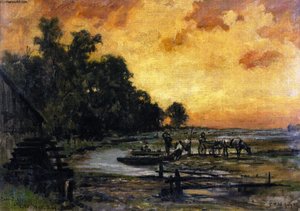
A Life Painted on Long Island: The World of Charles Henry Miller
Charles Henry Miller, born in Yorkville, New York, in 1891 and passing in 1980, was an American artist whose work resonated with a uniquely personal vision. Though he initially pursued medical training, graduating from the New York Homeopathic Medical College, his true calling lay within the realm of artistic expression. This wasn’t a simple abandonment of one path for another; rather, it was a merging of observation, empathy honed by medical study, and an intense desire to capture the essence of the world around him – particularly the landscapes and people of Long Island. Miller's journey began with formal training at the National Academy of Design, but his artistic spirit yearned for broader horizons, leading him to Munich and further studies across Europe. These experiences profoundly shaped his style, blending a meticulous realism with an emerging sensitivity to light and atmosphere that would become hallmarks of his work. He wasn’t merely depicting scenes; he was imbuing them with feeling, with the weight of human experience.From Realism to Revelation: Artistic Development
Miller's early works demonstrate a strong grounding in traditional landscape painting, reminiscent of the Hudson River School but infused with a more intimate and personal touch. He possessed an exceptional ability to render detail – the texture of bark on a tree, the play of light on water, the subtle nuances of human expression. However, he wasn’t content to simply replicate what he saw. As his career progressed, Miller began to experiment with bolder compositions, looser brushwork, and a more subjective use of color. This evolution was partly fueled by his association with artists in Europe, but it also stemmed from an internal drive to explore the emotional and philosophical dimensions of his subjects. His paintings became less about topographical accuracy and more about conveying a sense of place, a feeling of belonging – or alienation – within the natural world. Highbridge from Harlem Line in 1873, for example, isn’t just a depiction of an engineering marvel; it's a meditation on progress, industry, and their impact on the landscape. His later watercolors, created during his time in Big Sur, California, reveal a further distillation of his style – a lyrical abstraction that captures the essence of the environment with remarkable economy and grace.Influences and Associations: A Network of Ideas
Miller’s artistic journey wasn't undertaken in isolation. His connections to other creative minds played a crucial role in shaping his vision. Perhaps most notably, his relationship with Anaïs Nin provided both emotional support and financial assistance during his formative years in Paris. This association exposed him to a vibrant intellectual circle and encouraged his experimentation with form and content. Beyond Nin, Miller engaged with the broader artistic currents of his time, absorbing influences from Impressionism, Pointillism – as evidenced by echoes of Seurat’s techniques – and even early Surrealist ideas. He wasn't simply imitating these styles; he was synthesizing them into something uniquely his own. His intellectual curiosity extended beyond the visual arts, leading him to explore philosophical questions about art, society, and the human condition. This is reflected in his published work, Moloch: or, this gentile world, a novel that remained unpublished for decades but reveals a deeply critical and unconventional worldview.Legacy and Lasting Impact
Charles Henry Miller’s legacy extends beyond the canvases he created. He was a champion of artistic innovation, a tireless advocate for new ideas, and a mentor to younger artists. His willingness to challenge conventional norms paved the way for future generations of American painters. While his work wasn't always widely recognized during his lifetime, it has gained increasing appreciation in recent years as scholars and collectors rediscover his unique contribution to American art. Today, his paintings can be found in museums and private collections around the world, offering viewers a glimpse into a world seen through the eyes of a truly original artist. His evocative landscapes, imbued with philosophical depth and emotional resonance, continue to inspire and captivate audiences, reminding us of the power of art to illuminate the human experience. Exploring his work alongside that of artists like Claude Monet provides valuable context for understanding the artistic landscape of his time, while recognizing his distinct voice within it.Q&A
Charles Henry Miller 작가의 작품을 감상할 수 있는 3D 갤러리는 어디인가요?
Charles Henry Miller의 작품은 작가의 3D 갤러리 페이지 내 3D 갤러리에서 감상하실 수 있습니다.
Charles Henry Miller 작품의 연도별 타임라인이 있나요?
Charles Henry Miller의 작품을 연도별로 정리하여 보여주는 작품 연대기 페이지입니다.
Charles Henry Miller의 전 작품에 걸친 색채 활용을 살펴볼 수 있을까요?
Charles Henry Miller의 팔레트 지놈에서는 작가의 작품 세계를 구성하는 컬러 프로필을 확인하실 수 있습니다.