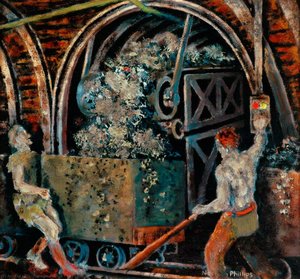
The Industrial Soul of Norman Phillips
The art of Norman Phillips serves as a profound window into the raw, unyielding spirit of industrial life and the visceral human experience. While many artists of his era sought to capture the idyllic or the purely decorative, Phillips turned his gaze toward the grit, the labor, and the heavy atmosphere of the working world. His work is characterized by an extraordinary ability to find a haunting beauty within the shadows of coal mines and the structural complexity of industrial landscapes. Through his mastery of oil painting, he transformed scenes of toil into monumental studies of resilience and human endurance.
Phillips’ artistic language is deeply rooted in a command over texture and light. He often employed a thick impasto technique, allowing the paint to sit heavily upon the canvas, creating a physical topography that mirrors the ruggedness of his subjects. In works such as Thorne Colliery Landscape, one can sense the weight of the earth and the atmospheric density of the industrial setting. His use of muted tones and dark, somber hues does not merely depict a scene; it evokes a mood of solemnity and strength, pulling the viewer into a world where the boundaries between man and machine, or laborer and landscape, begin to blur.
A Spectrum of Expression and Form
The evolution of Phillips’ style reveals an artist unafraid to traverse the boundaries between realism and more experimental modes of expression. While his depictions of industrial life, such as the poignant Last Run, lean into a realistic and romanticized portrayal of a coal miner’s arduous labor, other facets of his oeuvre venture into the realms of Expressionism and Cubism. This versatility allowed him to explore the human form not just as a physical entity, but as a vessel for primal emotion and psychological depth.
In his more abstract or experimental works, Phillips utilized fragmented forms and intertwined figures to communicate complex internal states. Notable examples include:
- Backbreaker: A hauntingly beautiful study of vulnerability, where the use of thick texture and muted tones creates a powerful sense of primal emotion through the nude form.
- Derailed: A striking piece that utilizes Cubist influences and dark hues to depict intertwined male figures, evoking an intense, almost claustrophobic emotional tension.
This duality—the ability to move from the documentary-like precision of industrial landscapes to the fractured, emotive intensity of Expressionism—is what defines his unique contribution to modern art. He did not merely paint what he saw; he painted the weight of what was felt.
Legacy and Artistic Significance
The historical significance of Norman Phillips lies in his refusal to look away from the harder edges of existence. His work stands as a testament to the dignity of labor and the profound emotional landscapes found within the most challenging environments. By blending the grit of industrial realism with the emotive power of modern expressionist techniques, he created a body of work that resonates with both historical weight and timeless human truth. Today, his paintings continue to captivate collectors and art enthusiasts alike, offering a powerful, tactile connection to a vanished era of industrial strength and the enduring resilience of the human spirit.
질의응답
Norman Phillips 작품의 연도별 타임라인이 있나요?
Norman Phillips의 작품 연표를 확인해 보세요: 작품 연대기 페이지에서 작품들을 제작 날짜순으로 보실 수 있습니다.
Norman Phillips의 모든 작품은 어디에서 볼 수 있나요?
본 웹사이트에 등록된 Norman Phillips의 모든 작품은 작가의 모든 작품 보기 페이지에서 확인하실 수 있습니다.
Norman Phillips 작가의 작품을 감상할 수 있는 3D 가상 투어가 있나요?
가상 방문이 가능합니다: Norman Phillips의 3D 뮤지엄 페이지에서 작가의 작품들을 3D 갤러리를 통해 만나보실 수 있습니다.