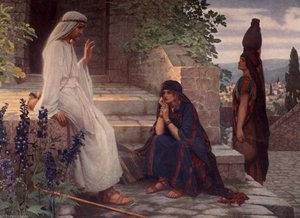
The Genesis of a Victorian Visionary
Born in the quiet surroundings of Ryton on Tyne in 1856, Herbert Gustave Schmalz emerged as a painter whose soul was deeply entwined with the romanticism of his era. His artistic journey began with the disciplined training of the South Kensington Art School, but it was at the Royal Academy of Arts that his true potential began to unfurl under the watchful eyes of masters such as Frank Dicksee and Stanhope Forbes. This rigorous academic foundation was further enriched by his time in Antwerp, where the influence of the Royal Academy of Fine Arts instilled in him a technical virtuosity that would become his hallmark. Schmalz’s early development was marked by a pursuit of perfection, blending the structured discipline of his mentors with an innate sensitivity to the emotional weight of his subjects.
A Fusion of Classical Grace and Orientalist Wonder
Schmalz’s work is a profound dialogue between the established traditions of the Pre-Raphaelite movement and a burgeoning fascination with the exotic allure of the East. Unlike many of his contemporaries who remained tethered to purely Western motifs, Schmalz looked toward Persia and Egypt, weaving these distant, sun-drenched landscapes into his narratives. His artistic repertoire is characterized by several defining elements:
- The mastery of light and texture, particularly in how sunlight interacts with the delicate folds of classical drapery to create a luminous contrast.
- An evocative use of color that captures the vibrant, often dramatic atmosphere of historical and biblical settings.
- A meticulous attention to detail that breathes life into every architectural ledge and distant figure within his sprawling compositions.
Sacred Narratives and the Legacy of Faith
The spiritual dimension of Schmalz’s oeuvre reached its zenith following his transformative pilgrimage to Jerusalem in 1890. This journey breathed new life into his religious compositions, leading to the creation of poignant biblical scenes such as Return from Calvary. These works are not merely historical recreations but are deeply emotive explorations of loss, faith, and divine presence. Even as he later adopted the name Herbert Carmichael in 1918, his commitment to the profound themes of Christian art remained unshakable. His refusal to embrace the fleeting trends of Impressionism allowed him to maintain a steadfast devotion to the enduring power of the figure and the sanctity of the story, securing his place as a definitive voice in late Victorian painting.
问答详情
Herbert Gustav Schmalz 还以哪些名称为人所知?
Herbert Gustav Schmalz 也被称为 Herbert Gustave Schmalz, Herbert Carmichael。
我可以通过主题来探索 Herbert Gustav Schmalz 的作品吗?
主题图谱 页面按主题对 Herbert Gustav Schmalz 的作品进行了分类索引。
Herbert Gustav Schmalz 的艺术生涯是如何划分为不同时期的?
您可以在艺术家的 艺术编年史 页面上查阅 Herbert Gustav Schmalz 作品的编年史,其作品按创作顺序分章节依次呈现。