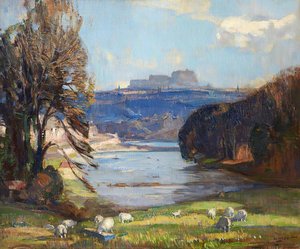
Robert Hope (1869–1936): A Highland Visionary
Robert Hope Moncrieff, born February 26, 1846, in Liverpool, England, was a Scottish artist whose prolific output cemented his place as one of Scotland’s most celebrated landscape painters. His father, George Moncrieff, was a solicitor, and Angela Birch, his first wife, tragically succumbed to tuberculosis just two years later. Despite this early loss, Robert’s life flourished, marked by marriage to Margaret Sutherland-Todd in 1873 and the birth of several children. He pursued legal studies alongside artistic endeavors, demonstrating a balanced intellectual curiosity that would inform his distinctive style.- Early Influences: Hope's formative years were shaped by exposure to Victorian art movements, particularly Romanticism and Impressionism. Artists like Turner and Constable instilled in him a fascination with capturing atmospheric effects and conveying emotion through color and light—principles he would consistently uphold throughout his career.
- Academic Training & RSA Membership: He studied at the Royal Scottish Academy (RSA), gaining invaluable experience in mastering traditional techniques and honing his observational skills. His membership in the RSA signaled recognition of his talent and commitment to artistic excellence, establishing him as a respected figure within Scotland’s art community.
The Highland Landscape: Hope's Signature Style
Hope’s artistic reputation rests primarily on his breathtaking depictions of Scottish Highlands landscapes. He possessed an unparalleled ability to render the rugged beauty of Skye, Loch Lomond and Glencoe with remarkable accuracy and sensitivity. His canvases pulsated with vibrant hues—deep greens, rich browns, and brilliant blues—reflecting the dramatic interplay of light and shadow characteristic of Highland weather conditions. Unlike many contemporaries who favored idealized representations, Hope sought to portray the Highlands as they truly appeared: weathered by time, imbued with history, and brimming with untamed energy. He meticulously documented geological formations, vegetation patterns, and atmospheric phenomena, demonstrating a dedication to scientific observation alongside artistic expression.- Technique & Detail: Hope employed a meticulous glazing technique—applying thin layers of translucent paint over subsequent coats—to achieve unparalleled luminosity and depth. This painstaking process allowed him to capture subtle tonal variations and create textures that conveyed the tactile qualities of stone, heather, and water.
- Notable Works: Among his most celebrated paintings are “The Old Shepherd,” “Glen Coe” and “The Heather Moor,” each showcasing Hope’s masterful command of color and composition. These works exemplify his commitment to portraying Highland life with dignity and respect, capturing the spirit of rural Scotland in exquisite detail.
Beyond Landscape: Portraits & Impressionistic Explorations
While landscapes dominated Hope's oeuvre, he also produced a significant body of portraiture—primarily commissioned by wealthy patrons—characterized by refined elegance and psychological insight. He skillfully captured the likenesses of prominent figures from Scottish society, conveying not merely physical appearance but also character and emotion. His portraits often incorporated elements of Impressionistic technique—loose brushstrokes and dappled color—reflecting his broader artistic interests and experimentation with innovative approaches to painting. “Before the Looking Glass,” a striking portrait featuring Margaret Sutherland-Todd, exemplifies this stylistic fusion, demonstrating Hope’s versatility as an artist.Legacy & Recognition
Robert Hope Moncrieff enjoyed considerable acclaim during his lifetime and posthumously received recognition for his contribution to Scottish art history. He was elected Fellow of the Royal Society of Edinburgh in 1908—a testament to his scholarly pursuits and artistic achievements—and served as President of the RSA from 1926 to 1930. His paintings continue to inspire admiration for their beauty, precision, and evocative portrayal of Highland life. Today, Hope’s work resides in numerous museums and private collections worldwide, ensuring that his vision of Scotland endures as a symbol of artistic excellence and national pride.问答详情
如何按特定色调查找 Robert Hope 的作品?
您可以在Robert Hope的按色调浏览页面上,按色调浏览其作品。
Robert Hope 的作品传达了怎样的情绪?
艺术家的 情境空间 页面按氛围分类展示了 Robert Hope 的艺术作品。
Robert Hope 的艺术生涯是如何划分为不同时期的?
Robert Hope 的艺术生涯在 艺术历程 页面上按时期逐一展开:以横向时间轴的形式呈现作品,并按创作时期划分为不同的篇章。