

 Vorschau anzeigen
 Versenden
 Teilen
 Details anzeigen
 Leitfaden

 Herunterladen
 Ähnliche Objekte
 Röntgenaufnahme
 Diashow
 Statistiken
juil-14
 Acrylic On Canvas
- WallArt
- Tubism
 1914
1914- Modern
 65.0 x 58.0 cm
 Weiterlesen
Handgefertigte Ölreproduktion
Handgemaltes Ölgemälde auf Leinwand in Ihrer Wunschgröße und mit Rahmen, auf Bestellung von unseren Künstlern angefertigt. ( Zum Druck wechseln Zum digitalen Bild wechseln)




P118B €10

P118H €10

P118W €10

P438Z €10

P508JH €12

P508YH €12

P805H €10

P805Z €10

P919BZ €10

P919G €10

P919XJ €10

P959ZH €10

P968JZ €12

W106C €8

W218G €10

W218JH €8

W218Y €10

W307PJ €10

W316G €10

W316PJ €8

W316Y €10

W398PJ €8

W4111J €10

W500HY €15

W500JH €15

W692G €12

W849H €8

W940BG €15

W953PJ €8




Wählen Sie aus unseren vordefinierten Formaten, die den ursprünglichen Proportionen des Kunstwerks entsprechen.

Geben Sie die Breite und die Höhe an, die Sie für Ihren Rahmen oder Ihre Wand benötigen. Da dieses Werk handgemalt ist, kann der Künstler bei einer anderen Form etwas mehr um das Bild herum malen oder etwas abschneiden – Sie entscheiden. Wir senden Ihnen ein digitales Mockup zur Freigabe, bevor mit dem Malen begonnen wird. Das auf dieser Seite gezeigte Bild stellt nicht das tatsächliche Ergebnis dar – dies tut nur das Mockup.
Nach der Bestellung wird das WikiOO.org-Team dem Kunden Anweisungen per E-Mail zusenden und eine Mockup-Vorschau bereitstellen.
Weltweiter Versand () in nur 3 bis 4 Wochen statt der üblichen 5 Wochen. (25 Oktober). Keine Kompromisse bei der Qualität.

Kostenloser weltweiter Expressversand

Hochwertige Leinenleinwand

Umfassender Versicherungsschutz beim Versand

Zollgebühren-Rückerstattungsgarantie

Garantie für exakte Farbtreue

100 Tage Rückgaberecht (nur bei Mängeln)

100% Geld-zurück-Garantie

Mengenrabatt verfügbar
 Die Glasoption ist nur für Größen unter 110 cm verfügbar.

juil-14
Art der Reproduktion
Format der Reproduktion
-


Endpreis
€ 233
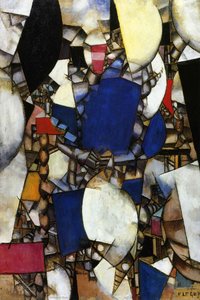
Fernand Léger’s ‘juil-14’: A Vibrant Echo of Modernity
“juil-14,” painted in 1914 by Fernand Léger, is more than just a colorful abstraction; it's a potent distillation of the anxieties and aspirations swirling through Europe at the dawn of the 20th century. Executed during Leger’s pivotal period within the Tubism movement, this artwork embodies his radical attempt to reconcile the burgeoning industrial world with artistic expression. The canvas explodes with a dynamic interplay of red, blue, green, yellow, white, and black – colors that resonate with both the vibrancy of urban life and the starkness of mechanized forms. The presence of trees in the background offers a grounding element, a subtle nod to the rural origins that shaped Leger’s artistic sensibility, while scattered flags introduce an immediate sense of national identity, subtly hinting at the impending storm.
Tubism: Integrating the Machine Age
Created in Tubism style – a movement Léger himself pioneered – “juil-14” reflects his core philosophy. Tubism sought to break down objects into their geometric components, then reconstruct them in abstract forms, often emphasizing angularity and repetition. This is vividly apparent here; the shapes aren’t simply decorative; they are echoes of industrial machinery, a deliberate engagement with the dominant aesthetic of the age. Léger wasn't rejecting representation entirely, but rather transforming it to capture the essence of modernity – its speed, its power, and its inherent geometric logic. The painting’s bold, fragmented forms evoke the feeling of shattered perspectives, mirroring the disruption caused by rapid technological advancement.
Symbolism and Historical Context
The title itself, “juil-14,” immediately anchors the artwork to a specific historical moment: Bastille Day, July 14th, 1789 – the anniversary of the French Revolution. While seemingly anachronistic within the abstract composition, this inclusion subtly layers meaning. The flags, prominent throughout the piece, represent not just national pride but also the volatile political climate of 1914, a year that would soon erupt in global conflict. Léger’s choice to depict this iconic event through such a radically modern lens suggests a questioning of tradition and an embrace of a new, uncertain future. The artwork was created just months before the outbreak of World War I, adding another layer of poignant significance.
Technique and Emotional Impact
Léger’s technique in “juil-14” is characterized by broad, confident brushstrokes and a deliberate lack of blending. This creates a sense of raw energy and immediacy, further amplifying the painting's dynamism. The composition isn’t static; it feels as though the forms are constantly shifting and interacting. The overall effect is one of controlled chaos – an emotional response to the anxieties and possibilities of a world undergoing profound transformation. This reproduction captures that same vibrant intensity, offering a powerful visual statement for any collection or interior space.
Fragen & Antworten
Welcher Raum passt farblich zu "juil-14" von Fernand Léger?
Die Earthy-Farben von "juil-14" von Fernand Léger passen perfekt zum empfohlenen Raum: einem Living Room.
Kann ich "juil-14" von Fernand Léger vor der Bestellung in einer Vorschau ansehen?
Eine Vorschau von "juil-14" von Fernand Léger finden Sie auf der Vorschau im Raum-Seite des Kunstwerks.
Welche Farbpalette und welche Leitfarbe prägen "juil-14"?
Die Farbidentität von "juil-14" von Fernand Léger: eine Earthy-Palette, dominiert von Rosy Brown (#a59785).
Ähnliche Kunstwerke




Künstlerbiografie
frühes Leben und Ausbildung
Fernand Légér, ein französischer Maler, Bildhauer und Filmemacher, wurde am 4. Februar 1881 in Argentan, Orne, Niedergermanien geboren. Sein Vater züchtete Rinder, und Légér erhielt zunächst eine Ausbildung als Architekt von 1897 bis 1899. Er zog dann im Jahr 1900 nach Paris und unterstützte sich dort als Architektenzeichner.Künstlerische Entwicklung
Légers frühe Werke wurden vom Impressionismus beeinflusst, wie in Le Jardin de ma Mère (Mein Muttergarten) (1905) zu sehen ist. Nach dem Besuch der Schule für dekorative Künste und der Académie Julian begann er ab seinem 25. Lebensjahr ernsthaft als Maler zu arbeiten. Sein Stil entwickelte sich zu einer persönlichen Form des Kubismus, der von Kritikern als "Tubism" bezeichnet wurde, da er sich auf zylindrische Formen konzentrierte.Kubismus und die Puteaux-Gruppe
Im Jahr 1910 stellte Légér im Salon d’Automne zusammen mit Jean Metzinger und Henri Le Fauconnier aus. Er schloss sich der Puteaux-Gruppe an, auch bekannt als die Section d’Or (die Goldene Proportion), zusammen mit anderen Künstlern wie Francis Picabia und Marcel Duchamp.Krieg und seine Auswirkungen auf Légers Werk
Légers Erfahrungen im Ersten Weltkrieg hatten einen erheblichen Einfluss auf sein Werk. Während seiner Zeit an der Front produzierte er Skizzen von Artilleriegeschützen, Flugzeugen und Soldaten. Sein Gemälde Soldat mit Pfeife (1916) spiegelt diese Zeit wider.Spätere Werke und Vermächtnis
Légers Nachkriegszeitliche Arbeiten, die von glatten, maschinellen Formen geprägt waren, verknüpften ihn mit der Tradition der französischen figurativen Malerei. Seine "animierten Landschaften" von 1921 zeigten Figuren und Tiere in harmonischen, stromlinienförmigen Formen.- Fernand Légers Werke auf WikiOO
- Mehr über Fernand Légér auf Wikipedia
- Entdecken Sie das Musée National Fernand Légér (Frankreich) mit WikiOO
- Die Sitzende Frau (100 x 81 cm, Tubism)
- Maschinenelement (Kubismus)

Fernand Léger
1881 - 1955 , Frankreich
Kurzinfos
- Beeinflusste Kunstrichtungen: ['Pop Art']
- Beeinflusste Künstler: ['Paul Cézanne']
- Bemerkenswerte Werke:
- Die Sitzende Frau
- Maschinenelement
- Der Große Umzug
- Die Stadt
- Geburtsdatum: 04. Februar 1881
- Geburtsort: Argentan, Frankreich
- Künstlerische Richtung: Kubismus, Tubismus
- Nationalität: Französisch
- Sterbedatum: 1955
- Vollständiger Name: Fernand Léger
- Von Kunstbewegungen Beeinflusst: ['Cézannismus']
- Von Künstlern Beeinflusst: ['Impressionismus']
Ähnliche Artikel

Abstrakter Expressionismus: Die 10 Meisterwerke, die eine Kunstbewegung prägten |
Entdecken Sie die 10 Meisterwerke des Abstrakten Expressionismus! Von Jackson Pollock bis Mark Rothko – erfahren Sie die Geschichten hinter ikonischen Gemälde und finden Sie hochwertige Reproduktionen für Ihr Zuhause. Jetzt bei entdecken!

Fernand Léger: Die 25 Meisterwerke des Kubismus für Ihr Zuhause | WikiOO
Entdecken Sie die 25 Meisterwerke von Fernand Léger! Tauchen Sie ein in die Welt des Kubismus, Tubismus & der Avantgarde. Hochwertige Kunstreproduktionen für Ihr Zuhause – jetzt auf WikiOO.org!

Geometrische Abstraktion: Die 10 Meisterwerke, die Kunstgeschichte prägten | WikiOO.org
Entdecken Sie die 10 Meisterwerke der geometrischen Abstraktion! Von Kandinsky bis Mondrian – erleben Sie die Geschichte, Farben & Formen dieser revolutionären Kunstrichtung. Hochwertige Kunstreproduktionen auf WikiOO.org

Kandinsky: Die 25 Meisterwerke des Abstrakten – Kunst für Ihr Zuhause | WikiOO
Entdecken Sie die 25 bedeutendsten Gemälde von Wassily Kandinsky! Tauchen Sie ein in die Welt der abstrakten Kunst, des Expressionismus und der Farbkomposition. Hochwertige Kunstdrucke & Inspiration für Ihr Zuhause auf WikiOO.org.

Giclée Prints: Archival Quality & Aesthetic Nuances for the Discerning Collector
Explore the world of giclée prints with WikiOO. Learn about archival quality, aesthetic nuances & investment potential. Expert guidance for discerning art collectors seeking museum-quality reproductions and lasting value.


