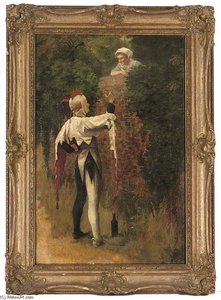
The Illustrative Spirit of George Derville Rowlandson
Born in the vibrant landscape of Secunderabad, India, in 1861, George Derville Rowlandson emerged as a painter whose vision was deeply rooted in the traditions of British sporting and rural life. While his early years were shaped by the colonial atmosphere of his birthplace, his artistic soul was forged in the prestigious studios of Europe. Studying at the Gloucester Art School, the Westminster School of Art in London, and later refining his eye in Paris, Rowlandson developed a versatile command over both oil and watercolor. His career began not with the grand canvas, but through the meticulous precision of illustration, contributing evocative works to renowned publications such as The Illustrated London News and the English Illustrated Magazine. This early period of graphic work instilled in him a keen eye for detail and a narrative clarity that would later define his most celebrated paintings.
As his mastery grew, Rowlandson transitioned from the ephemeral world of newsprint to the enduring medium of fine art, exhibiting his talents at prestigious venues like the British Institution and the Royal Institute of Serpentine Painters in Watercolours. His subject matter was a rich tapestry of the Victorian and Edwardian eras, ranging from tender figure scenes to the rugged energy of hunting expeditions. He became particularly renowned for his equestrian portraits, capturing the powerful grace of horses and the spirited tension of the hunt with an authenticity that resonated with the sporting community. Beyond the stable and the field, his work often turned toward the quiet dignity of landscapes and the intimate charm of animal studies, where he could explore the subtle interplay of light and texture.
A Legacy of Motion and Light
The true brilliance of Rowlandson’s technique lies in his ability to breathe life into static subjects. Whether depicting a man pausing on horseback for a moment of respite or the playful chaos of puppies in a top hat, he possessed an uncanny knack for capturing transient moments—the fleeting glance, the sudden movement, or the soft glow of dusk over a meadow. His approach to watercolor allowed him to manipulate pigments to suggest atmospheric depth, while his oil paintings showcased a robust handling of form and light that echoed the realism of his era. This duality made him a significant figure in capturing the essence of a changing Britain, bridging the gap between traditional sporting art and a more modern, observational style.
Rowlandson’s historical significance is further cemented by his role as one of the first official artists of the First World War, a period that brought a somber gravity to his repertoire. His life was not without personal tragedy, as evidenced by the loss of his eldest son in the conflict, yet his artistic output remained a testament to the enduring beauty of the natural and social worlds he observed. Today, his works reside in esteemed collections such as the Museum of Polo and Hall of Fame, serving as a window into a bygone era of elegance, athleticism, and rural splendor. Through his brush, the spirit of the English countryside and the nobility of the equestrian tradition continue to endure.
Ερωτήσεις και Απαντήσεις
Υπάρχει 3D εικονική περιήγηση στα έργα του George Derville Rowlandson;
Τα έργα τέχνης του/της George Derville Rowlandson μπορούν να περιηγηθούν σε μια 3D γκαλερί στη σελίδα 3D Μουσείο του καλλιτέχνη/της.
Πώς μπορώ να δείτε όλα τα έργα του/της George Derville Rowlandson;
Μπορείτε να περιηγηθείτε σε όλα τα έργα του/της George Derville Rowlandson στο αυτή η ιστοσελίδα μέσω της σελίδας με την πλήρη συλλογή τους (Όλα τα έργα).
Πώς μπορώ να βρω έργα του/της George Derville Rowlandson με ένα συγκεκριμένο θέμα;
Στη σελίδα Με Λέξεις-Κλειδιά του George Derville Rowlandson, τα έργα του καλλιτέχνη ομαδοποιούνται ανά λέξεις-κλειδιά.