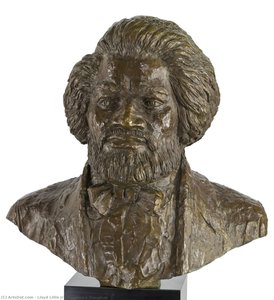
The Weight of Bronze and History
To look at the bronze works of Lloyd Lillie Jr. is to confront American history without the softening lens of myth. He did not merely replicate faces; he anchored historical figures in physical reality through a rigorous commitment to anatomical precision. His sculptures, ranging from the bust of Frederick Douglass to the expansive 20-figure installation The First Wave, demand attention through their sheer presence. There is no abstraction here to hide behind. Instead, there is the heavy, undeniable truth of musculature and bone structure, rendered in metal and clay.
His approach was grounded in a specific, disciplined lineage. Having studied at the Corcoran School of Art in Washington, D.C., and later at the School of the Museum of Fine Arts, Boston, Lillie built his technique on a foundation of classical rigor. His time in Florence, supported by the Clarissa Bartlett Traveling Fellowship, allowed him to absorb the traditions of the Accademia di Belle Arti. This training informed a style that favored the weight of reality over the lightness of idealism. He understood how a body moves and how a figure occupies space.
A Legacy in Public Space
Lillie’s significance is best measured by where his work resides. His commissions were not mere decorations but permanent fixtures in the American landscape. In Seneca Falls, New York, his work for the Women’s Rights National Historical Park brings the organizers of the 1848 convention into the physical reach of the visitor. He had a specific talent for bringing figures down from pedestals. By placing sculptures at a human level, he forced a direct encounter between the viewer and the subject.
His repertoire covered a wide spectrum of American identity:
- Political figures such as Thomas Jefferson, John Adams, and Abigail Adams.
- Civil rights leaders including Booker T. Washington.
- Local Boston legends like Red Auerbach and Mayor James Michael Curley.
- The movement of everyday life, captured in pieces like Chess Players and Children Reading.
Technical Precision and Observation
The strength of his work came from a refusal to settle for static poses. Lillie found his most compelling movements in the moments when models were not performing. He watched for the natural gestures that occur during a break, capturing a sense of motion that felt unforced. This eye for detail extended to his use of materials, whether working in bronze casting, terra cotta, or clay. Even in smaller works like Figure Stretching, the anatomical correctness provides a sense of tension and release.
Beyond the studio, Lillie’s life was defined by a similar discipline. A member of the US Army Band during the Korean War, he brought a musician's sense of rhythm to his sculptural compositions. As a professor at Boston University for decades, he passed this technical rigor to a new generation of artists. He remained a practitioner of the fundamental truth that art must possess a palpable presence to truly communicate.
Ερωτήσεις και Απαντήσεις
Ποιες διαθέσεις εκφράζουν τα έργα του/της Lloyd Lillie Jr.;
Στη σελίδα Κόρνερ Αίσθησης του Lloyd Lillie Jr., τα έργα του καλλιτέχνη είναι διατεταγμένα ανάλογα με τη διάθεση.
Μπορώ να εξερευνήσω τα έργα του/της Lloyd Lillie Jr. ανά φάσμα χρωμάτων;
Η σελίδα Δείκτης Χρώματος οργανώνει τα έργα του/της Lloyd Lillie Jr. ανά χρώμα.
Πόσα έργα του/της Lloyd Lillie Jr. είναι διαθέσιμα για περιήγηση;
Μπορείτε να περιηγηθείτε σε 1 έργα τέχνης έργα του Lloyd Lillie Jr. στη σελίδα Όλα τα έργα.