

 Preview
 Send
Send Share
Share
 Details
 Guide
Guide

 Download
 Similars
 X-Ray
X-Ray Diaporama
 Stats
StatsInterior


 Read More
Hand Made Oil Reproduction
Hand-painted oil on canvas in your size and frame, made to order by our artists. ( Switch to Print Switch to Digital Image)




P118B $10

P118H $10

P118W $10

P438Z $10

P508JH $12

P508YH $12

P805H $10

P805Z $10

P919BZ $10

P919G $10

P919XJ $10

P959ZH $10

P968JZ $12

W106C $8

W218G $10

W218JH $8

W218Y $10

W307PJ $10

W316G $10

W316PJ $8

W316Y $10

W398PJ $8

W4111J $10

W500HY $15

W500JH $15

W692G $12

W849H $8

W940BG $15

W953PJ $8




Pick from our preset sizes that match the artwork's original proportions.

Type the width and the height you need, to fit your frame or your wall. This is hand-painted, so for a size with a different shape the artist can paint a bit more around the picture, or cut a bit — you choose. We send you a digital mockup to approve before the painting starts. The picture shown on this page does not show the real result — only the mockup does.
After order, WikiOO.org team will email client for instructions and provide a mockup preview
Worldwide Delivery () in 3/4 weeks instead of standard 5 weeks. (25 October). No compromise on quality.

Free Worldwide Express Shipping

High-Quality Linen Canvas

Full Shipping Insurance

Customs Tax Refund Guarantee

True Color Matching Guarantee

100-Day Return Policy (Defects Only)

100% Money-Back Guarantee

Bulk Discount Offer
 Glass option is only available in size under 110 CM

Interior
Reproduction Medium
Reproduction Size
-


Total Price
$ 265
Related Artworks


Artist Biography
The Architect of the High Renaissance
Donato Bramante stands as one of the most transformative figures in the history of Western architecture, a visionary who bridged the gap between the late Gothic traditions and the luminous dawn of the High Renaissance. Born as Donato di Pascuccio d'Antonio in Fermignano, Italy, his journey through the artistic landscapes of Milan and Rome allowed him to reshape the very fabric of sacred and secular spaces. While he was also a painter, his true legacy lies in his ability to translate humanist ideals into stone, introducing a sense of mathematical grace and classical harmony that would define an entire era of European design.
His early career in Milan served as a fertile ground for experimentation, where he began to move away from the rigid, vertical structures of the Gothic period toward a more balanced, rhythmic approach. In works such as his depictions of the Exterior of the Church for Santa Maria delle Grazie, one can observe the emergence of a profound dialogue between the earthly and the divine. Bramante utilized the language of antiquity—Corinthian capitals, sturdy classical columns, and intricate geometric marvels like rose windows—to create structures that felt both monumental and intimately serene. His architectural philosophy was deeply rooted in the rediscovery of Greek and Roman wisdom, employing precise mathematical ratios and the golden section to achieve a sense of celestial order.
A Legacy of Innovation and Illusion
As Bramante’s influence expanded toward Rome, he became a central figure in the development of the High Renaissance style. His mastery was not limited to mere construction; he possessed an uncanny ability to manipulate space and perception. This is perhaps most brilliantly realized in his work at Santa Maria presso San Satiro, where he employed architectural magic to dissolve the boundaries between reality and art, creating illusions that transcended physical limitations. His talent for orchestration is also evident in the Tempietto, a small, freestanding chapel that serves as a masterpiece of proportion and a symbolic tribute to the site of Saint Peter’s martyrdom.
Beyond his structural achievements, Bramante's work often embodied the spiritual aspirations of his age. His designs for the Vatican, including the breathtaking Bramante Staircase with its double helix design, were intended to elevate the papal residence into a symbol of divine authority. Even in his rarer known paintings, such as Christ at the Column, there is a palpable sense of the psychological depth and meticulous observation that characterized his entire oeuvre. Through his ability to blend the heavy weight of stone with the lightness of spirit, Donato Bramante did more than build monuments; he crafted a visual language for the soul of the Renaissance.

Donato Bramante
1444 - 1514 , Italy
Quick Facts
- Artistic Movement Or Style: High Renaissance
- Artists Or Movements Influenced By This Artist: ['Michelangelo']
- Full Name: Donato di Pascuccio d'Antonio
- Nationality: Italian
- Notable Artworks:
- Tempietto
- Christ at the Column
- Spiral Staircase
- Exterior of the Church
- Place Of Birth: Fermignano, Italy
- Date Of Birth: 1444
- Date Of Death: 1514
Related Articles

Shadows & Splendor: A Journey Through the Soul of Gothic Art and Architectural Grandeur
Embark on a profound journey through the spiritual intensity of Gothic art. Explore the architectural marvels, luminous stained glass, and sacred sculptures that define this era of grandeur and human devotion.
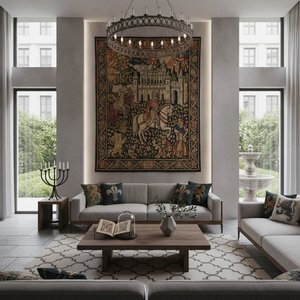
Timeless Elegance: How to Integrate High Medieval Art into Your Modern Interior Design
Discover how to infuse your modern home with the divine light of High Medieval art. From gilded illuminated manuscripts to Gothic-inspired textures, learn expert tips for integrating timeless elegance and historical grandeur into contemporary interior design.

Gothic Art Guide for Hotel Designers: Leveraging Dramatic Shadows and Architectural Grandeur in Luxury Interiors
Elevate hospitality interiors with our expert guide to Gothic art. Discover how to leverage dramatic shadows, architectural grandeur, and high-end reproductions to create sophisticated, atmospheric hotel spaces that captivate guests.

Gothic Glamour Reimagined: How Late Medieval Aesthetics are Driving the Next Big Interior Design Trend
Discover how Late Medieval art is revolutionizing modern interiors. From Gothic drama to Renaissance naturalism, learn to integrate high-impact, historical aesthetics into your urban space with expert trend forecasts and design inspiration.

Late Gothic Art: The Divine Transition from Medieval Symbolism to Renaissance Naturalism
Explore the profound transition of Late Gothic art from medieval symbolism to Renaissance naturalism. Discover the elegance of International Gothic, the legacy of Master Theodoric, and the evolution of European courtly masterpieces through an expert art-historical lens.


