Preview
 Send
Send Share
Share
 Details
 Guide
Guide

 Download
 Similars
 X-Ray
X-Ray Diaporama
 Q&A
Q&A Stats
StatsLook closer
Every detail, painted by hand
Three spots of the painting, enlarged. Our artists reproduce each of them by hand, at the size you choose.
i.
The heart of the scene.
ii.
Light and background.
iii.
The brushwork.
The painting
Collectible Description
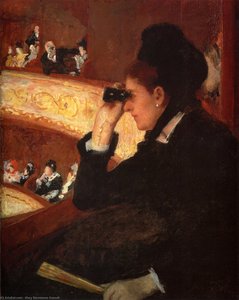
Mary Stevenson Cassatt’s ‘Bacchante’ captures a melancholic beauty in an Impressionistic portrait. Explore the loose brushwork, rich textures & evocative mood of this Romantic masterpiece.
Artist Biography
An Impressionist master known for The Child's Bath. Discover her intimate portrayals of women and children today.
 Read More

Mary Stevenson Cassatt
1843 - 1926, United States of America
The painter
Artist Biography
Early Life, Family and Training
Allegheny City, Pennsylvania, provides the setting for the birth of Mary Stevenson Cassatt on May 22, 1844. She enters a family of French Huguenot descent, a lineage that brings a sense of cosmopolitanism to her upbringing. Her father, Robert Simpson Cassat, operates as a successful stockbroker and land speculator. Her mother, Katherine Kelso Johnston, arrives from a banking family. Among the seven children in the household, two die in infancy. The environment is one of wealth and progressive cultural values.
The path toward professional practice begins in Philadelphia. From 1860 to 1862, Mary Stevenson Cassatt studies at the Pennsylvania Academy of the Fine Arts. This period marks her formal entry into the technical rigors of the discipline. She does not rely solely on classroom instruction; instead, she seeks out the halls of the Louvre. There, she spends her days performing the repetitive, disciplined task of daily copying. This immersion in the presence of the old masters provides a foundation of technical skill and observation that formal academies often lack.
Artistic Training in France and Italy
By 1865, the determination to study in Paris succeeds. The move shifts her focus from the Pennsylvania Academy of the Fine Arts toward the rigorous academic traditions of France. She takes private lessons from Jean-Léon Gérôme, a leading academic painter, absorbing the technical foundations of the era. Her training expands as she moves through Courance and Écouen, studying under Édouard Frère and Paul Soyer. These years are defined by the discipline of the studio and the pursuit of formal mastery.
In 1872, the scene shifts to Parma, Italy. For eight months, she immerses herself in the works of Correggio and Parmigianino. Under the guidance of Carlo Raimondi, the head of the department of engraving at the Parma Academy, she refines her technical precision. This period of study provides a direct connection to the masters of the Italian tradition, grounding her developing eye in the nuances of classical composition and form.
The momentum continues into 1873. She travels through Spain, Belgium, and Holland, moving between galleries and studios to study and copy the works of Velázquez, Rubens, and Hals. This extensive period of observation across Europe allows her to absorb a diverse range of European styles, from the dramatic light of the Spanish masters to the brushwork of the Dutch tradition. She is no longer merely a student of the academy; she is a traveler collecting the visual languages of a continent.
Association with the Impressionist Circle
Paris, 1874. Cassatt settles into the city, moving within a landscape of shifting artistic loyalties. The traditional Salon remains the established authority, but a new, independent energy is gathering in the cafes and studios of the French capital. In 1877, Edgar Degas extends an invitation that alters her trajectory, bringing her into the orbit of the group of independent artists who will become known as the Impressionists. She is the only American officially associated with this circle.
The connection is not merely social; it is professional and profound. Cassatt exhibits with the Impressionists in 1879, 1880, 1881, and 1886. She remains a member of this circle until 1886. Her presence in the group provides a bridge between American sensibilities and the radical avant-garde movements taking hold in Europe. She navigates this space with a fierce independence, maintaining a distinct perspective even as she aligns with their revolutionary approach to light and modern life.
Technique and Distinctive Artistic Style
The canvas becomes a private stage for the social and domestic realities of women. Cassatt moves away from grand historical narratives to focus on the quiet, intimate bonds between mothers and children. Her brushstrokes are soft, creating an atmosphere that feels immediate and lived-in. She utilizes a palette of bright colors to define these domestic spaces, often capturing the subtle shifts of light within a room. This focus on the private sphere allows for a psychological depth that distinguishes her from many of her contemporaries.
Her technical approach is diverse, spanning oil painting, pastel, engraving, and printmaking. A significant shift occurs through her engagement with Japanese ukiyo-e woodblock prints. This influence manifests in her compositions through flattened perspectives and a sophisticated use of pattern. She adopts the directness of these prints to arrange forms within a space, often utilizing asymmetrical layouts. This stylistic intersection, combined with the mentorship of Edgar Degas, shapes a visual language that is both structured and fluid.
Key Works and Masterpieces
The trajectory of her career finds an early marker in 1868, when The Mandolin Player gains acceptance at the Paris Salon. This moment signals her entry into the rigorous professional circles of France. Years later, the focus shifts toward the intimate and the domestic. In 1883, Lady at the Tea Table appears in the Metropolitan Museum of Art, New York, capturing a quiet, private ritual through a sophisticated palette of muted creams, deep browns, and luminous blue accents. The same year, she produces Portrait of Alexander J. Cassatt, a work that reflects the personal connections woven into her professional output.
The artist’s ability to translate maternal bonds into visual form reaches a peak in works like The Child's Bath, currently held at the Art Institute of Chicago. These compositions move beyond simple documentation, focusing instead on the psychological depth of the subjects. In 1904, her ability to command the attention of the art world is confirmed when The Caress wins prizes in two prestigious shows of contemporary American art. This recognition follows a career spent navigating the tension between academic tradition and the evolving modernism of the Impressionist circle.
- The Mandolin Player (1868)
- Lady at the Tea Table (1883)
- Portrait of Alexander J. Cassatt (1883)
- The Caress (1904)
Legacy and Historical Influence
Cassatt breaks through the rigid structures of the 19th-century art establishment. She remains one of only three women to exhibit with the French Impressionists, a distinction that marks her presence in the radical shifts of the Parisian scene. While her contemporaries often focused on grand historical narratives, she directs the gaze toward the private, domestic realities of women. This focus is not merely aesthetic; it is a quiet rebellion. Beyond the canvas, she turns her attention to the political, supporting women's suffrage and advocating for the visibility of her gender in both social and artistic spheres.
Her influence extends into the very foundations of American art collections. Acting as an art collecting advisor and buying agent for the Havemeyer family, she shapes the tastes of major collectors. She actively encourages American collectors to acquire Impressionist works, bridging the gap between European innovation and American institutions. This influence ensures that the radical ideas she embraced in France find a permanent home in the United States. Her impact is recognized by her induction into the National Women's Hall of Fame in 1973.
Quick facts about Mary Stevenson Cassatt
- Artistic Movement Or Style: Impressionism
- Artists Or Movements Influenced By This Artist: ['American Impressionism']
- Artists Who Influenced This Artist:
- Edgar Degas
- Jean-Léon Gérôme
- Velázquez
- Rubens
- Hals
- Full Name: Mary Stevenson Cassatt
- Nationality: American
- Notable Artworks:
- The Mandolin Player
- The Child's Bath
- The Boating Party
- Lady at the Tea Table
- Place Of Birth: Allegheny City, United States of America
- Date Of Birth: 1843
- Date Of Death: 1926


Hand Made Oil Reproduction
Have it painted for you
Hand Made Oil Reproduction
Hand-painted oil on canvas in your size and frame, made to order by our artists. ( Switch to Print Switch to Digital Image)

Your commission

Bacchante
Reproduction Medium
Reproduction Size
-

Elite Senior Artist
More detail, finesse, and extra production time
-

Reproduction Frame
-
-
For artworks or reproductions larger than 105 cm (approximately 41 inches) on any side, the frame will be shipped as a kit, disassembled. This method ensures safe delivery and prevents damage during transport.
Professional assembly required - this is not a DIY product.
The kit must be assembled and the canvas stretched by an experienced professional framer, using wood glue (not supplied), a canvas stretching plier and clamps to hold the bars square while the glue dries. Incorrect assembly or uneven canvas tension can permanently damage the artwork and is not covered by our warranty.
 For artworks or reproductions larger than 105 cm (approximately 41 inches) on any side, the frame will be shipped as a kit, disassembled. This method ensures safe delivery and prevents damage during transport.
All solid wood bars are included, precisely cut to size.
Assembled with the screws provided, plus wood glue for the corner joints, which is not supplied and must be sourced by your framer.
Professional tools are required and not included: a canvas stretching plier (tensioner) and clamps to hold the bars square while the glue dries.
Important:
The corner joints require wood glue, the bars must be held with clamps until the glue is fully dry, and tightening the canvas on the assembled frame requires a canvas stretching plier. None of these are included in the kit. Please arrange an experienced professional framer before ordering this size.

Nameplate
-
-

Protective Varnish
Glossy Varnish (enhances colors, protects against light/moisture)
-

Customize My Artwork
Examples of what can be changed: Replace face with customer photo; Add pet (e.g., replace cat with dog); Include hidden message in background; Change background landscape or elements.
-

Urgent
Worldwide Delivery () in 3/4 weeks instead of standard 5 weeks. (10 November). No compromise on quality.
-
Express Shipping
Worldwide Delivery () in 5 weeks. (17 November).
Included
Total Price
$ 265
Glass option is only available in size under 110 CM
i.
Scale
Slide to your wall: every size keeps the proportions of the original.
Pick from our preset sizes that match the artwork's original proportions.

Type the width and the height you need, to fit your frame or your wall. This is hand-painted, so for a size with a different shape the artist can paint a bit more around the picture, or cut a bit — you choose. We send you a digital mockup to approve before the painting starts. The picture shown on this page does not show the real result — only the mockup does.
ii.
Frame
The frame is drawn on the painting at its true width.
Framed

White $1

Blurside $1

Extended $1

P118B $10

P118H $10

P118W $10

P438Z $10

P508JH $12

P508YH $12

P805H $10

P805Z $10

P919BZ $10

P919G $10

P919XJ $10

P959ZH $10

P968JZ $12

W106C $8

W218G $10

W218JH $8

W218Y $10

W307PJ $10

W316G $10

W316PJ $8

W316Y $10

W398PJ $8

W4111J $10

W500HY $15

W500JH $15

W692G $12

W849H $8

W940BG $15

W953PJ $8

H24-GOLD $30

H24-SILVER $30

H36-GOLD $45

H36-SILVER $45
iii.
Make it yours
A painting made by hand can be made for one person.
iv.
Finishing
Nameplate, varnish and delivery.
Nameplate
Engraved Bronze Plaque Details
This elegant plaque features the artist's name and the title of the artwork, finely engraved for a timeless presentation.
It is made from bronze with a refined, elegant finish. The text is precisely laser-engraved for a sharp and permanent result. Measuring 9x2 cm, the plaque is compact yet easy to read. It's built to be durable and scratch-resistant, offering a professional, museum-quality look. Mounting is simple thanks to the included adhesive backing.
Transparent Acrylic Plaque Details
The plaque includes essential engraved details such as the artist's name, the title of the artwork, the date it was created, the type of media used-like oil on canvas or watercolor-a brief description of the piece, and a QR code that links to the complete artwork information.
It is crafted from clear acrylic, offering a sleek, modern appearance. The text is UV-engraved in black to ensure strong visual contrast. With a size of 10x15 cm, it ensures optimal readability. It comes equipped with two metal hooks for secure wall mounting. The plaque is designed to be weather-resistant, making it suitable for various environments, and it includes interactive features that work seamlessly with smartphone scanning.
Black Acrylic Plaque Details
This elegant plaque includes engraved information such as the artist's name, the title of the artwork, the date it was created, the type of media used (like oil on canvas or watercolor), a short description of the artwork, and a QR code for quick access to more information.
The plaque itself is made from refined black acrylic with a premium finish. The text is laser-engraved in white for high contrast and readability. Its size is 10x15 cm, designed to be easy to read. It comes with two metal hooks for professional mounting. The design is sleek and fits any interior style. It is also weather-resistant and durable, with built-in digital integration for mobile compatibility.
Protective Varnish
Urgent Production
Worldwide Delivery () in 3/4 weeks instead of standard 5 weeks. (10 November). No compromise on quality.
- Free Worldwide Express Shipping
- High-Quality Linen Canvas
- Full Shipping Insurance
- Customs Tax Refund Guarantee
- True Color Matching Guarantee
- 100-Day Return Policy (Defects Only)
- 100% Money-Back Guarantee
- Bulk Discount Offer


Quick facts and art quiz
Related Articles

Mary Cassatt: Modernity, Motherhood & the Impressionist Gaze – A Timeless Legacy
Explore the life & art of Mary Cassatt, a pivotal American Impressionist renowned for intimate portrayals of women & children. Discover her unique style, legacy, and groundbreaking techniques at WikiOO.

Romantic Realism's Finest: 10 Masterpieces for Your Home | WikiOO
Explore 10 defining masterpieces of Romantic Realism! Discover Courbet, Millet & Daumier's powerful paintings—capturing emotion and social realities. Find museum-quality reproductions for your home at WikiOO.org.

Impressionistic Landscapes: 10 Masterpieces That Changed Art & Decor
Journey into the heart of Impressionism! Explore 10 masterpieces by Monet, Renoir & Degas that revolutionized landscape art. Discover their stories, techniques & find museum-quality reproductions to elevate your home decor on WikiOO.org.

Capturing the Soul: The Most Emotionally Moving Impressionist and Post-Impressionist Masterpieces
Discover the profound emotional depth of Impressionist and Post-Impressionist masterpieces. Explore how legends like Monet, Van Gogh, and Gauguin captured light and soul through evocative landscapes and vibrant brushwork for a timeless connection to art history.
Related Artworks