Early Life and Career
- Born: April 4, 1876, Paris, France
- Died: October 11, 1958
- Maurice de Vlaminck was born in Paris to a Flemish father who taught violin and a mother from Lorraine who taught piano. This musical upbringing influenced his artistic sensibility.
- He began painting relatively late in life, around the age of 20. Initially self-taught, he developed a passionate and instinctive approach to art.
The Fauvist Movement and Artistic Style
- Vlaminck is considered a key figure in the Fauve movement (1904-1908), characterized by its intense use of color and simplified forms.
- Alongside André Derain and Henri Matisse, he was part of this revolutionary group that challenged traditional artistic conventions.
- His style is marked by:
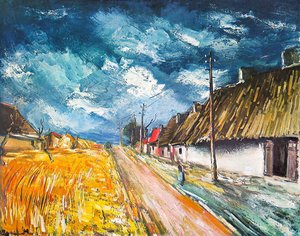
- Bold Color Choices: Vlaminck used vibrant, non-naturalistic colors to express emotion rather than represent reality accurately.
- Energetic Brushwork: His paintings feature thick, visible brushstrokes that convey a sense of dynamism and spontaneity.
- Simplified Forms: He often reduced objects and landscapes to their essential shapes, prioritizing expressive power over detailed representation.
- Notable early works include "Sur le zinc" (At the Bar) and "L'homme à la pipe" (Man Smoking a Pipe), showcasing his distinctive style.
Influences and Artistic Development
- Impressionism: Vlaminck’s compositions demonstrate familiarity with Impressionist techniques, particularly in their focus on capturing fleeting moments and the effects of light.
- Vincent van Gogh: A profound influence on Vlaminck was Vincent van Gogh. After visiting a Van Gogh exhibition, he famously declared his admiration for the artist. This is evident in Vlaminck's expressive brushwork and emotional intensity.
- Paul Cézanne: From 1908 onwards, Vlaminck’s palette shifted towards more monochromatic tones, influenced by the work of Paul Cézanne.
- Later Work: His later paintings often featured a darker palette with heavy strokes of contrasting white paint, reflecting a shift in his artistic focus and emotional expression.
Major Achievements and Historical Significance
- Vlaminck’s participation in the Salon d'Automne exhibitions (particularly in 1905) helped to establish Fauvism as a significant force in modern art.
- His paintings are celebrated for their raw energy, emotional intensity, and innovative use of color.
- He played a crucial role in bridging the gap between Impressionism and Expressionism, paving the way for future artistic developments.
- Vlaminck’s work continues to be admired for its unique blend of spontaneity, passion, and technical skill.
Legacy and Available Works
- Today, Vlaminck's works are held in numerous museums and private collections worldwide.
- His paintings, such as "Bougival" and "The Bridge at Chatou," remain highly sought after by art collectors.
- WikiOO offers a selection of his artworks for viewing and purchase, providing an opportunity to experience the vibrancy of his Fauvist style.
Questions & Answers
Can I browse Maurice de Vlaminck's works by movement?
Maurice de Vlaminck's works can be browsed by movement on the artist's All Movements page.
What are the birthplace and birth year of Maurice de Vlaminck?
Maurice de Vlaminck was born in Paris in 1876.
Where are Maurice de Vlaminck's artworks organized by color?
Maurice de Vlaminck's works can be explored by color on the artist's Spectral Index page.