- 322.0 x 512.0 cm


 Voorvertoning
 Verstuur
 Delen
Delen
 Details bekijken
 Gids
Gids

 Download
 Vergelijkbare items
 Röntgenonderzoek
 Diavoorstelling
 Q&A
Q&A Statistieken
Look closer
Every detail, painted by hand
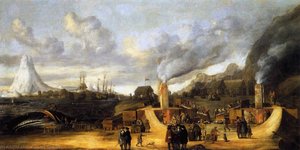
Meesterwerk van Jan Matejko: 'Bathory in Pskov' (1872). Een indrukwekkende historische schilderij over politieke macht en diplomatie, vol details en symboliek.
i.
The heart of the scene.
ii.
Light and background.
iii.
The brushwork.
The painting
De Pracht van Pskov: Een Monumentale Weergave van Stephen Báthory
Jan Matejko’s “Bathory at Pskov” (1872) is meer dan een schilderij; het is een krachtige, emotionele reis terug in de tijd. Deze monumentale compositie, met afmetingen van 322 x 512 cm, toont een fictieve scène die de complexiteit en de grandeur van de Livonische campagne belichaamt. Het werk, dat zich afspeelt in Pskov, is een symfonie van kleur, detail en dramatische compositie – een perfect voorbeeld van het romantische nationalisme dat in de 19e eeuw Polen domineerde.
De kern van het schilderij ligt in de verbeeldende ontmoeting tussen Poolse koning Stephen Báthory en Russische edelen. Matejko, met zijn meesterlijke oog voor detail, heeft een scene gecreëerd waarin diplomatie, macht en politieke intriges samenkomen. De centrale figuur, koning Báthory, zit aan een tafel vol documenten en symbolische objecten, omringd door een levendige menigte van soldaten, ambassadeurs en religieuze vertegenwoordigers. De scène is doordrenkt van een gevoel van urgentie en spanning, terwijl de onderhandelingen over vrede in volle gang zijn.
Een Schilderij Vol Symboliek en Historische Betekenis
“Bathory at Pskov” is rijk aan symbolen die dieper ingaan op de historische context. De aanwezigheid van de pauselijke legaat, Antonio Possevino, benadrukt het belang van de katholieke kerk in deze geopolitieke strijd. De Poolse vlag en de Russische troepen symboliseren de rivaliteit tussen de twee koninkrijken, terwijl de documenten op tafel beloven overeenkomsten en afspraken te vertegenwoordigen. Het schilderij is niet alleen een weergave van een historische gebeurtenis; het is een statement over Poolse trots en veerkracht.
De keuze voor Pskov als setting is bijzonder interessant. De stad, gelegen aan de rivier de Luga, was een strategisch punt in de Livonische oorlog, een conflict dat decennia lang de relaties tussen Polen en Rusland had gekenmerkt. Matejko’s schilderij vangst niet alleen de politieke spanningen van die tijd, maar ook de culturele verschillen en de complexiteit van diplomatieke onderhandelingen.
De Meesterlijke Techniek van Jan Matejko
Matejko’s techniek is een bewijs van zijn meesterschap als schilder. Hij gebruikt een rijke, warme kleurenpalet – dominanter goud, rood en diepe aardtinten – om de scène te verlichten en een gevoel van luxe en macht uit te dragen. De details zijn adembenemend: de kostuums van de figuren, de wapens, de tenten en de achtergrondlandschap zijn allemaal met uiterste zorg gerepresenteerd. De penseelstreek is zichtbaar, wat een gevoel van textuur en dynamiek toevoegt aan het schilderij.
Het gebruik van licht en schaduw creëert een dramatische compositie die de aandacht van de kijker vestigt op de belangrijkste figuren. De zonsondergangs kleuren – mengsels van roze, oranje, paars en goud – versterken het emotionele effect van het schilderij en dragen bij aan de sfeer van grandeur en spanning.
Een Monument voor Poolse Identiteit
“Bathory at Pskov” is meer dan een historisch schilderij; het is een symbool van Poolse identiteit. Matejko’s werk weerspiegelt de wens van de Polen om hun geschiedenis te eren en hun nationale trots te versterken. Het schilderij werd in 1872 geëxposeerd, en het werd onmiddellijk een succes, wat de impact van zijn boodschap op het publiek aantoont. Het is een blijvende herinnering aan een belangrijke periode in Poolse geschiedenis en een bewijs van de artistieke genialiteit van Jan Matejko.
Vandaag de dag blijft “Bathory at Pskov” een fascinerend kunstwerk dat bewonderd wordt om zijn historische betekenis, techniek en emotionele impact. Het is een schilderij dat je meeneemt op een reis terug in de tijd, waardoor je de grandeur van het Poolse koninkrijk en de complexiteit van de Livonische campagne kunt ervaren.
Veelgestelde vragen
Is "Bathory in Pskov" te bekijken via een augmented reality-preview?
"Bathory in Pskov" heeft een augmented reality-preview: de AR-weergave-pagina van het kunstwerk toont het in uw eigen ruimte op een compatibel apparaat.
Is "Bathory in Pskov" door Jan Matejko eerder licht of donker van kleur?
Wat betreft de waargenomen helderheid is "Bathory in Pskov" door Jan Matejko gebalanceerd.
Welke sfeer brengt "Bathory in Pskov" in een ruimte?
De Dramatisch sfeer van "Bathory in Pskov" door Jan Matejko past perfect bij de aanbevolen ruimte: een Hotellobby's.

Jan Matejko
1838 - 1893, Polen
The painter
Jan Matejko (1838-1893) schilderde episch historische taferelen, waaronder de Slag bij Grunwald en de Unie van Lublin. Zijn romantische stijl toont belangrijke momenten uit de Poolse geschiedenis.
Biografie kunstenaar
Early Life and Education
Jan Alojzy Matejko, a name synonymous with Polish historical painting, was born on June 24th, 1838, in the heart of Kraków, Poland – a city steeped in history and brimming with artistic fervor. His father, Franciszek Ksawery Matejko, a Czech-born tutor and musician, provided an early exposure to music and education, while his mother, Joanna Karolina Rossberg, instilled in him a deep appreciation for culture and the arts. Jan’s childhood was profoundly shaped by two pivotal events: the Kraków Revolution of 1846 and the subsequent Austrian siege of Kraków in 1848. These experiences, witnessing firsthand the struggles for Polish independence and enduring the hardships of occupation, would become recurring themes and powerful motivators throughout his artistic career. Despite facing challenges with traditional academic subjects, young Jan displayed an extraordinary talent for art from a remarkably early age. He enrolled at St. Ann’s High School, but unfortunately, his grades were consistently poor, leading to his premature departure in 1851. However, this didn't deter him; instead, he immediately pursued his passion by entering the School of Fine Arts in Kraków, where he honed his skills under the tutelage of esteemed artists such as Wojciech Korneli Stattler and Władysław Łuszczkiewicz, specializing in the dramatic and evocative realm of historical painting.Artistic Career: A Chronicle of Polish History
Matejko’s artistic journey truly began to blossom with the completion of *Tsars Shuyski before Zygmunt III* in 1853 – a monumental work that immediately established his reputation for capturing pivotal moments in Polish history with remarkable detail and dramatic flair. From this initial success, he steadily gained recognition within the Kraków Society of Friends of Fine Arts, exhibiting his historical paintings to enthusiastic audiences. His oeuvre quickly expanded to encompass a vast range of subjects, each imbued with a potent sense of national pride and a deep understanding of Polish identity. Among his most celebrated works are *Rejtan* (1866), depicting a courageous act of defiance against the Russian authorities; *Union of Lublin* (1869), a meticulously rendered portrayal of this crucial political event that shaped Poland’s future; and, perhaps most famously, *Battle of Grunwald* (1878). This colossal canvas – nearly 10 meters long – is considered his magnum opus, a breathtaking spectacle of color, movement, and emotion that vividly recreates the epic clash between Polish and Lithuanian forces against the Teutonic Knights. Matejko’s ability to convey the intensity of battle, the heroism of individual soldiers, and the overwhelming scale of the event cemented his place as one of Poland's greatest historical painters.Museological Contributions and a Lasting Legacy
Beyond his artistic achievements, Jan Matejko played a significant role in shaping the cultural landscape of Kraków. He eventually assumed the position of director at the Jan Matejko Academy of Fine Arts (formerly known as the Kraków Academy of Fine Arts), an institution he profoundly influenced and nurtured. During his tenure, he attracted a remarkable cohort of talented students – including Maurycy Gottlieb, Jacek Malczewski, Józef Mehoffer, and Stanisław Wyspiański – many of whom went on to become prominent figures in Polish art and culture. Matejko’s influence extended far beyond the walls of his academy; he was deeply involved in the preservation and promotion of Polish heritage. His paintings served not only as artistic masterpieces but also as powerful symbols of national identity, reminding Poles of their rich history and inspiring a sense of pride and patriotism. He understood that art could be more than mere decoration; it could serve as a vital tool for shaping public opinion and fostering a shared cultural consciousness.A National Painter Remembered
Jan Matejko passed away on November 1st, 1893, in Kraków, leaving behind an unparalleled legacy as Poland’s most celebrated painter – often referred to as the “National Painter.” His works continue to be revered and studied today, serving as enduring testaments to his artistic skill, historical knowledge, and unwavering dedication to portraying the story of Poland. His paintings are displayed prominently in museums throughout Poland and beyond, ensuring that his vision of Polish history and identity will continue to inspire generations to come.Quick facts about Jan Matejko
- Artistic Movement Or Style: Romanticisme
- Artists Or Movements Influenced By This Artist: ['Maurycy Gottlieb']
- Artists Who Influenced This Artist:
- Wojciech Korneli Stattler
- Władysław Łuszczkiewicz
- Date Of Birth: 24 juni 1838
- Date Of Death: 1 november 1893
- Full Name: Jan Alojzy Matejko
- Nationality: Pools
- Notable Artworks:
- Slag bij Grunwald
- Unie van Lublin
- Place Of Birth: Kraków, Polen

Handgemaakte olieverfreproductie
Have it painted for you
Handgemaakte olieverfreproductie
Met de hand geschilderd in olieverf op canvas in uw gewenste maat en lijst, op bestelling gemaakt door onze kunstenaars. ( Schakel over naar print Schakel over naar digitale afbeeldingen)

Your commission

Bathory in Pskov
Druktechniek
Afmetingen reproductie
-

Geselecteerde topkunstenaars
Meer detail, verfijning en extra productietijd
-

Lijst voor reproductie
-
-
Voor kunstwerken of reproducties die aan één zijde groter zijn dan 105 cm (ongeveer 41 inch), wordt de lijst als een losse set verzonden. Deze methode garandeert een veilige levering en voorkomt schade tijdens het transport.
Professionele montage vereist - dit is geen doe-het-zelfproduct.
De set moet worden gemonteerd en het canvas moet worden gespannen door een ervaren professionele lijstenmaker, met gebruik van houtlijm (niet inbegrepen), een doekspanter en klemmen om de sponningen recht te houden terwijl de lijm droogt. Onjuiste montage of een ongelijkmatige spanning op het canvas kan het kunstwerk permanent beschadigen en wordt niet gedekt door onze garantie.
 Voor kunstwerken of reproducties die aan één zijde groter zijn dan 105 cm (ongeveer 41 inch), wordt de lijst als een losse set verzonden. Deze methode garandeert een veilige levering en voorkomt schade tijdens het transport.
Alle massief houten onderdelen zijn inbegrepen, nauwkeurig op maat gesneden voor montage.
Te monteren met de meegeleverde schroeven, plus houtlijm voor de hoekverbindingen, die niet wordt meegeleverd en door uw lijstenmaker moet worden aangeschaft.
Professioneel gereedschap is vereist en niet inbegrepen: een spanner voor canvas en klemmen om de latten recht te houden terwijl de lijm droogt.
Belangrijk:
De hoekverbindingen vereisen houtlijm, de latten moeten met lijmklemmen worden vastgehouden tot de lijm volledig is opgedroogd, en het spannen van het canvas op het samengestelde frame vereist een doekspanter. Geen van deze artikelen is inbegrepen in de set. Wij adviseren u om een ervaren professionele lijstenmaker te raadplegen voordat u deze maat bestelt.

Naamplaatje
-
-

Beschermende vernislaag
Glanzende vernis (versterkt de kleuren en biedt bescherming tegen licht en vocht)
-

Mijn kunstwerk aanpassen
Voorbeelden van aanpassingen: vervang het gezicht door een eigen foto; voeg een huisdier toe (bijv. vervang de kat door een hond); verwerk een verborgen boodschap in de achtergrond; wijzig het landschap of andere elementen op de achtergrond.
-

Spoedlevering
Wereldwijde levering () binnen 3 tot 4 weken in plaats van de standaard 5 weken. (31 oktober). Geen concessies aan de kwaliteit.
-
Spoedlevering
Wereldwijde levering naar binnen 5 weken. (7 november).
Inbegrepen
Eindtotaal
€ 591
De optie voor glas is alleen beschikbaar bij een formaat kleiner dan 110 cm.
i.
Scale
The original measures 322.0 x 512.0 cm. Slide to your wall: every size keeps its proportions.
Kies uit onze vooraf ingestelde maten die overeenkomen met de originele verhoudingen van het kunstwerk.

Voer de breedte en hoogte in die u nodig heeft, passend bij uw lijst of uw muur. Omdat dit handgeschilderd is, kan de kunstenaar bij een afmeting met een andere beeldverhouding iets meer rondom het schilderij schilderen of juist iets meer weglaten — u kiest zelf. Wij sturen u een digitaal mockup ter goedkeuring voordat het schilderwerk begint. De afbeelding die op deze pagina wordt getoond, is niet het uiteindelijke resultaat — alleen de mockup geeft dit weer.
 Lees meer over
ii.
Frame
The frame is drawn on the painting at its true width.
Ingelijst

White €1

Blurside €1

Extended €1

P118B €10

P118H €10

P118W €10

P438Z €10

P508JH €12

P508YH €12

P805H €10

P805Z €10

P919BZ €10

P919G €10

P919XJ €10

P959ZH €10

P968JZ €12

W106C €8

W218G €10

W218JH €8

W218Y €10

W307PJ €10

W316G €10

W316PJ €8

W316Y €10

W398PJ €8

W4111J €10

W500HY €15

W500JH €15

W692G €12

W849H €8

W940BG €15

W953PJ €8

H24-GOLD €30

H24-SILVER €30

H36-GOLD €45

H36-SILVER €45
iii.
Make it yours
A painting made by hand can be made for one person.
After order, WikiOO.org team will email client for instructions and provide a mockup preview
iv.
Finishing
Nameplate, varnish and delivery.
Naamplaatje
Details van de gegraveerde bronzen plaat
This elegant plaque features the artist's name and the title of the artwork, finely engraved for a timeless presentation.
It is made from bronze with a refined, elegant finish. The text is precisely laser-engraved for a sharp and permanent result. Measuring 9x2 cm, the plaque is compact yet easy to read. It's built to be durable and scratch-resistant, offering a professional, museum-quality look. Mounting is simple thanks to the included adhesive backing.
Details transparante acrylplaat
The plaque includes essential engraved details such as the artist's name, the title of the artwork, the date it was created, the type of media used-like oil on canvas or watercolor-a brief description of the piece, and a QR code that links to the complete artwork information.
It is crafted from clear acrylic, offering a sleek, modern appearance. The text is UV-engraved in black to ensure strong visual contrast. With a size of 10x15 cm, it ensures optimal readability. It comes equipped with two metal hooks for secure wall mounting. The plaque is designed to be weather-resistant, making it suitable for various environments, and it includes interactive features that work seamlessly with smartphone scanning.
Details zwarte acrylplaat
This elegant plaque includes engraved information such as the artist's name, the title of the artwork, the date it was created, the type of media used (like oil on canvas or watercolor), a short description of the artwork, and a QR code for quick access to more information.
The plaque itself is made from refined black acrylic with a premium finish. The text is laser-engraved in white for high contrast and readability. Its size is 10x15 cm, designed to be easy to read. It comes with two metal hooks for professional mounting. The design is sleek and fits any interior style. It is also weather-resistant and durable, with built-in digital integration for mobile compatibility.
Beschermende vernislaag
Spoedproductie en -levering
Wereldwijde levering () binnen 3 tot 4 weken in plaats van de standaard 5 weken. (31 oktober). Zonder concessies aan de kwaliteit.
- Gratis wereldwijde expressverzending
- Hoogwaardig linnen canvas
- Volledige verzendverzekering
- Garantie op terugbetaling van invoerrechten
- Garantie op exacte kleurweergave
- Retourbeleid van 100 dagen (alleen bij defecten)
- 100% Geld-terug-garantie
- Korting bij meerdere afnames


Quick facts and art quiz
Gerelateerde artikelen

Top 10 Meesterwerken uit de 19e Eeuw: Kunstgeschiedenis voor uw Interieur
Ontdek de 10 meest iconische kunstwerken uit de 19e eeuw! Van romantiek tot impressionisme, leer het verhaal achter meesterwerken van Monet, Van Gogh & Delacroix. Vind museumkwaliteit reproducties en interieurinspiratie op WikiOO.org.

Jan Gossaert (Mabuse): Pioneering Renaissance Style & the Birth of Netherlandish Antiquity
Explore the groundbreaking art of Jan Gossaert (Mabuse), a pioneer of Renaissance painting in the Low Countries. Discover his Romanist style, stunning portraits, and influence on Northern European art history.

Stanisław Wyspiański: Symbolism, National Identity & the Polish Secession
Explore the life & work of Stanisław Wyspiański, a pivotal figure in Polish Symbolism and the Young Poland movement. Discover his iconic paintings, dramas, and stained glass designs reflecting national identity & artistic innovation.

Jan Brueghel the Elder: A Master of Flemish Landscape & Allegory – Exploring Innovation & Influence
Explore the captivating world of Jan Brueghel the Elder, a Flemish Baroque master renowned for his stunning landscapes & allegorical paintings. Discover his collaborations with Rubens and lasting artistic legacy.
Vergelijkbare kunstwerken