

 Voorvertoning
 Verstuur
 Delen
Delen
 Details bekijken
 Gids
Gids

 Download
 Vergelijkbare items
 Röntgenonderzoek
 Diavoorstelling
 Statistieken
Day and Night
 Oil On Canvas
- WallArt
- Surrealism
 1941
1941- Late Medieval
 112.0 x 146.0 cm
 Lees meer
De kunstwerken die op deze pagina worden weergegeven, zijn beschermd door de auteursrechtwetgeving, wat betekent dat het ons wettelijk niet is toegestaan om identieke reproducties te maken of te verkopen. Deze bescherming wordt gehandhaafd onder internationale overeenkomsten zoals de Conventie van Bern en door nationale wetgeving, waaronder de bepalingen van de Amerikaanse auteurswet - Titel 17. Alle rechten voorbehouden. Reproduceren of distribueren van afbeeldingen is niet toegestaan zonder uitdrukkelijke schriftelijke toestemming van WahooArt.com en de rechthebbenden.
Deze methode voldoet volledig aan de auteursrechtwetgeving, omdat het niet gaat om het kopiëren of dupliceren van het beschermde kunstwerk. In plaats daarvan is er sprake van een creatieve herinterpretatie — een nieuw schilderij dat door het origineel wordt geïnspireerd, maar er niet identiek aan is.
Giclée / Kunstafdrukken
Giclée- of canvasafdruk van museumkwaliteit met een snelle productie en flexibele afwerkingsmogelijkheden. ( Bestel handgeschilderde reproductie Schakel over naar digitale afbeeldingen)




P118B €10

P118H €10

P118W €10

P438Z €10

P508JH €12

P508YH €12

P805H €10

P805Z €10

P919BZ €10

P919G €10

P919XJ €10

P959ZH €10

P968JZ €12

W106C €8

W218G €10

W218JH €8

W218Y €10

W307PJ €10

W316G €10

W316PJ €8

W316Y €10

W398PJ €8

W4111J €10

W500HY €15

W500JH €15

W692G €12

W849H €8

W940BG €15

W953PJ €8




Kies uit onze vooraf ingestelde maten die overeenkomen met de originele verhoudingen van het kunstwerk.

Voer de gewenste breedte en hoogte in, passend bij uw lijst of muur. Een afdruk kan alleen worden ingekort en nooit groter worden gemaakt dan het origineel; een formaat met andere verhoudingen zal daarom een deel van de afbeelding verliezen. Wij sturen u een digitaal mockup ter goedkeuring voordat we tot drukwerk overgaan. De afbeelding op deze pagina toont niet de werkelijke uitsnede — dit is alleen te zien op het mockup.
Wereldwijde levering () binnen 2 weken in plaats van de standaard 4/5 weken. (26 oktober)

Gratis wereldwijde expressverzending

Hoogwaardig linnen canvas

Volledige verzendverzekering

Garantie op terugbetaling van invoerrechten

Garantie op exacte kleurweergave

Retourbeleid van 100 dagen (alleen bij defecten)

100% Geld-terug-garantie

Korting bij meerdere afnames
 De optie voor glas is alleen beschikbaar bij een formaat kleiner dan 110 cm.

Day and Night
Giclée / Kunstafdrukken
Afmetingen reproductie
-


Eindtotaal
€ 54
The Enigmatic Landscape of Dreams: Unpacking “Day and Night”
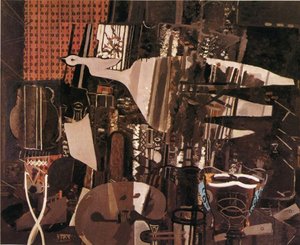
Max Ernst’s “Day and Night,” painted in 1941, isn't merely a depiction of opposing forces; it’s an immersive descent into the subconscious. This oil-on-canvas work, measuring a substantial 112 x 146 cm, immediately captivates with its layered complexity – a deliberate orchestration of fragmented images, embedded paintings, and scattered sculptures that defy easy interpretation. Ernst, a pivotal figure in both Dada and Surrealism, masterfully employs his signature technique to challenge the viewer’s perception, inviting us into a world where logic dissolves and dreams take precedence. The painting isn't about representing reality; it’s about evoking a feeling – a potent blend of mystery, disorientation, and profound psychological depth.
The initial impact is one of controlled chaos. Rectangular frames, reminiscent of picture windows or portals, dominate the composition, each containing miniature scenes that seem to bleed into one another. These aren’t static snapshots; they're glimpses of fleeting moments, distorted landscapes, and abstract textures. The deliberate use of repetition – the recurring presence of these framed images – creates a hypnotic effect, drawing the eye deeper into the painting’s intricate web. Notice how some frames seem to be looking out at us, while others are lost within their own contained worlds, suggesting an exploration of both introspection and external observation.
Surrealist Techniques: A Symphony of Disparate Elements
Ernst's genius lies in his ability to seamlessly blend seemingly incompatible elements. “Day and Night” is a prime example of his mastery of Surrealist techniques, particularly the incorporation of frottage – a method he pioneered involving rubbing textured materials onto paper to create random patterns – and decalcomania, where paint is transferred from one surface to another under pressure. These processes deliberately introduce chance and spontaneity into the creative process, liberating the artist from conscious control and allowing subconscious associations to emerge. The inclusion of sculptures further amplifies this effect; they aren’t simply decorative additions but integral components of the painting's narrative, adding a tactile dimension to the visual experience.
Consider the interplay of light and shadow within the framed images. Some scenes are bathed in an almost ethereal glow, suggesting twilight or dawn, while others are shrouded in darkness, hinting at the mysteries of night. This duality is not merely aesthetic; it reflects Ernst’s broader exploration of opposing forces – day versus night, consciousness versus unconsciousness, order versus chaos. The careful manipulation of color—primarily dark blues and browns punctuated by flashes of vibrant hues within the framed images—contributes significantly to this evocative atmosphere.
Historical Context & Symbolic Resonance
“Day and Night” was created during a period of immense social and artistic upheaval – the early 1940s, amidst the turmoil of World War II. Surrealism, as a movement, offered an escape from the horrors of reality by delving into the realm of dreams and the subconscious. Ernst’s work aligns perfectly with this ethos, providing a visual language for exploring anxieties, fears, and desires that lie beneath the surface of everyday life. The inclusion of embedded paintings within the larger composition can be interpreted as a commentary on art itself – questioning its ability to accurately represent reality or offering alternative pathways to understanding.
Furthermore, the painting’s symbolism is rich and layered. The scattered sculptures could represent fragments of memory, lost identities, or the remnants of shattered dreams. The overall composition suggests a journey through an internal landscape—a quest for meaning in a world seemingly devoid of order. It's a testament to Ernst's ability to distill complex psychological themes into a single, powerfully evocative image.
Bringing “Day and Night” Home: A Reproduction Worth Cherishing
WikiOO offers meticulously crafted hand-painted reproductions of Max Ernst’s “Day and Night,” allowing you to bring this extraordinary artwork into your own space. Our skilled artists replicate Ernst's intricate techniques with the utmost care, ensuring that every detail—from the subtle textures to the nuanced color palette—is faithfully reproduced. Whether adorning a gallery wall or serving as a focal point in a living room, this reproduction will serve as a constant source of contemplation and inspiration. Explore our high-resolution images and select the size and canvas material that best suits your vision. Discover more about “Day and Night” on WikiOO.
Veelgestelde vragen
Wat voor soort kunstwerk is "Day and Night" door Max Ernst?
In de catalogus is "Day and Night" door Max Ernst geclassificeerd als WallArt. Deze categorie helpt bij het vinden van vergelijkbare werken.
Hoe is "Day and Night" historisch gezien te plaatsen?
De kunsthistorische classificatie van "Day and Night" door Max Ernst is Surrealism, uit de Late Medieval-periode.
Maakt "Day and Night" door Max Ernst gebruik van sterke contrasten of zachte harmonieën?
In "Day and Night" wordt een Bold contrast gecombineerd met een Softly Mixed Palette harmonie.
Vergelijkbare kunstwerken




Biografie kunstenaar
A Life Immersed in the Surreal
Max Ernst, geboren Maximilian Maria Ernst op 1 april 1891 in Brühl, Duitsland, was een onrustige geest die tot een van de meest invloedrijke figuren van de 20e-eeuwse kunst werd. Zijn reis was geen van conventionele artistieke opleiding; eerder een zelfgeleide verkenning aangedreven door filosofische reflectie, psychologische fascinatie en een diepe teleurstelling met maatschappelijke normen. Ernst’s vader, leraar van de doven en amateur schilder, instilledde hem zowel gevoeligheid voor de wereld als een rebellie tegen gevestigde autoriteit. Deze vroege dualiteit zou een kenmerkende eigenschap worden van zijn artistieke visie.
Ernst’s academische inspanningen aan de Universiteit van Bonn – omvatten filosofie, kunstgeschiedenis, literatuur, psychologie en psychiatrie – waren niet alleen afleidingen maar fundamentele elementen die zijn latere werk diepgaand beïnvloedden. Hij was niet simpelweg geïnteresseerd in *hoe* te schilderen; hij worstelde met *waarom*. Deze intellectuele nieuwsgierigheid leidde hem tot het ontmoeten van baanbrekende werken van Picasso, Van Gogh en Gauguin op de Sonderbund tentoonstelling in Keulen in 1912, een moment dat zijn artistieke traject onherstelbaar veranderde. De zaden van modernisme waren gezaaid.
Dada’s Disruptie en de Geboorte van Surrealistische Visies
De catastrofe van de Eerste Wereldoorlog bleek een keerpunt te zijn voor Ernst. Zijn ervaringen als soldaat aan zowel het Oost- als Westfront lieten hem diepgaand gekwetst achter, wat leidde tot een diepe scepsis ten opzichte van gevestigde orde en een verlangen naar nieuwe vormen van expressie. Deze teleurstelling vond vruchtbare grond in de opkomende Dada beweging, waar hij vol overtuiging aanleunde na zijn terugkeer naar Keulen in 1918. Samen met Hans Arp – een levenslange vriend en collaborateur – werd Ernst een centrale figuur in de Keulse Dada groep, die traditionele artistieke conventies verwerkte en absurditeit, kans en anti-rationaliteit omarmde.
Dada was echter slechts een tussenstap. In het begin van de jaren 1920 migreerde Ernst naar Parijs en voegde hij zich bij de Surrealistische kring, geleid door André Breton. Dit markeerde een verschuiving richting het verkennen van het rijk van dromen, het onbewuste en de irrationele. Invloedrijk waren de psychoanalytische theorieën van Sigmund Freud, waarnaar Ernst op zoek ging om de verborgen dieptes van de menselijke ervaring te ontgrendelen door zijn kunst. Hij was niet geïnteresseerd in het weergeven van de werkelijkheid zoals deze voorkwam, maar eerder in het onthullen van de onderliggende psychologische krachten die deze vormden.
Pioniers Technieken: Frottage, Grattage en Collage
Ernst’s artistieke innovatie strekte zich uit voor de onderwerpkeuze; hij was een meesterlijke experimentator met techniek. Hij nam niet simpelweg bestaande methoden aan—hij verzinsde nieuwe. Misschien zijn meest bekende bijdragen is frottage, een proces van wrijven met potlood of houtskoor over getextureerde oppervlakken om onverwachte en evocatieve beelden te creëren. Deze techniek, geboren uit een moment van verveling terwijl hij naar houtnerf keek, stelde Ernst in staat om in de diepten van het onderbewustzijn te duiken en vormen te genereren die zich verzetten tegen bewuste controle. Dicht gerelateerd was grattage, waarbij verf over een doek wordt geschraapt om onderliggende lagen te onthullen.
Hij gebruikte ook meesterlijk collage, het samenstellen van uiteenlopende elementen – beelden uit tijdschriften, wetenschappelijke illustraties, foto’s – in surrealistische composities die conventionele ideeën over representatie uitdaagden. Deze technieken waren niet simpelweg stijlicheden—ze waren integraal aan zijn verkenning van het onbewuste en zijn wens om traditionele artistieke grenzen te verstoren. Zijn schilderijen bevatten vaak terugkerende symbolische beelden: vogels (vooral zijn alter ego Loplop), desolate landschappen, verontrustende juxtaposities en een doordringende mystiek.
Een Erfgoed van Innovatie en Invloed
De uitbraak van de Tweede Wereldoorlog dwong Ernst tot vlucht uit Europa, waar hij onderdak vond in de Verenigde Staten. Hij bleef schilderen en experimenteren met nieuwe technieken gedurende zijn ballingschap, uiteindelijk terugkeerend naar Frankrijk na de oorlog, waar hij actief bleef tot zijn dood op 1 april 1976, een dag voor zijn 85e verjaardag.
Ernst’s bijdragen aan Dada en Surrealisme waren niets minder dan baanbrekend. Hij daagde artistieke normen uit, duikelde in de diepten van het onbewuste en verzinsde innovatieve technieken die nog steeds kunstenaars inspireren. Hij was niet simpelweg een schilder—hij was een ontdekkingsreiziger, een provocateur en een visionair die de grenzen van de kunst zelf uitbreidde.
- Belangrijke Werken: The Entire City, Euclides, Ofrenda funeraria, The Equivocal Woman, L’Ange du foyer
- Invloeden: Pablo Picasso, Vincent van Gogh, Paul Gauguin, Sigmund Freud, Giorgio de Chirico
- Bewegingen: Dada, Surrealisme

Max Ernst
1891 - 1976 , Duitsland
Belangrijkste feiten
- Artistic Movement Or Style: Dada, Surrealisme
- Artists Or Movements Influenced By This Artist:
- Surrealisme
- Dada
- Artists Who Influenced This Artist:
- Picasso
- Van Gogh
- Gauguin
- Date Of Birth: 1 apr 1891
- Date Of Death: 1 apr 1976
- Full Name: Max Ernst
- Nationality: Duits/Amerikaans, Frans
- Notable Artworks:
- The Entire City
- Euclides
- Place Of Birth: Brühl, Duitsland
Gerelateerde artikelen

The Enduring Power of Painting: A Historical & Contemporary Exploration of Form and Emotion
Explore the rich history & enduring techniques of oil painting with WikiOO. Discover masterpieces, learn about art collecting, and find authentic handmade reproductions crafted by skilled artists.
Max Ernst's Top 25 Meesterwerken: Surrealisme voor uw Interieur | WikiOO
Ontdek de top 25 meesterwerken van Max Ernst, pionier van het surrealisme & dadaïsme. Duik in zijn droombeelden en unieke technieken. Museumkwaliteit kunst reproducties voor uw interieur op WikiOO.org. Exploreer de collectie online!

The Enduring Legacy of Oil on Canvas: Technique, History & Aesthetic Impact
Explore the rich history & techniques of oil painting – from Renaissance masters to Impressionism. Discover pigments, layering methods, and why this timeless medium endures. Expert insights for artists & art enthusiasts.

De Blijvende Erfenis van Olieverf op Doek: Techniek, Geschiedenis en Hedendaagse Praktijk
Ontdek de rijke geschiedenis en technieken van olieverfschilderen. Van Renaissance meesterwerken tot moderne toepassingen, leer over pigmenten, glazuur en conservering.

Oil on Canvas: A Historical & Technical Exploration of a Timeless Artistic Medium
Explore the rich history & enduring techniques of oil painting on canvas. Discover the science behind its longevity, conservation practices, and contemporary relevance. Expert insights for art enthusiasts.


