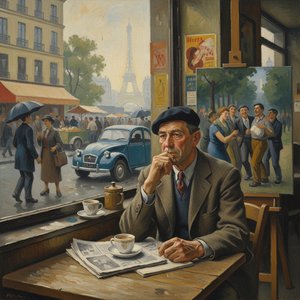
A Vision Born of Silence
The life of Maurycy Minkowski, often known as Maurice Minkowski, was defined by a profound and transformative silence. Born into a prosperous Jewish family in Warsaw, Poland, his world was irrevocably altered by a childhood illness that robbed him of both his hearing and his speech. Yet, where sound failed, sight flourished. This early tragedy did not stifle his creative impulse; instead, it seemed to sharpen his perception, forging an artistic voice that was uniquely attuned to the visual nuances of the world around him. His ability to observe without the distraction of sound allowed him to capture the subtle textures of life with an intensity that would become his hallmark.Academic Foundations and Artistic Evolution
Minkowski’s journey into the heart of fine art began with private tutelage, nurtured by parents who recognized a burgeoning talent in their son's drawings. His formal training led him to the prestigious Kraków Academy of Fine Arts, where he studied under masters such as Józef Mehoffer, Jan Stanisławski, and Leon Wyczółkowski. This rigorous academic environment provided him with a formidable technical foundation, which he would later infuse with deep emotional resonance. By 1905, his excellence was formally recognized when he graduated from the Academy with a gold medal. While his early explorations included portraiture and landscapes, his work began to shift toward a more profound social consciousness, moving beyond mere representation to document the human condition.Witness to a Vanishing World
The true power of Minkowski’s oeuvre lies in its role as a historical witness. Living through the tumultuous era of the Polish Revolution and the devastating pogroms that swept across Eastern Europe and Russia, he became a chronicler of displacement and resilience. He traveled to Odessa specifically to document the violence of the pogroms through a series of drawings, capturing the raw, cataclysmic events of his time. His paintings often focused on the shtetl life—the daily existence within Jewish communities in Eastern Europe—depicting women, children, and the elderly with an empathy born from his own experiences of hardship.Legacy and Historical Significance
Though he may have been a largely forgotten figure for periods of time, the significance of Minkowski’s work has been rediscovered by those seeking to understand the Jewish experience at the turn of the century. His art serves as a poignant bridge to a world on the brink of disappearance, offering a perspective that is both deeply personal and broadly historical. Through his canvases, the struggles and the quiet dignity of the victims of hatred and dislocation are given a permanent, visual voice. His legacy remains anchored in his ability to translate the profound silence of his own life into a powerful, enduring narrative of human endurance.Vraag en antwoord
Onder welke andere namen is Maurice Minkowski bekend?
Maurice Minkowski staat ook bekend onder de namen Moszek Minkowski.
Waar en wanneer is Maurice Minkowski geboren?
Maurice Minkowski werd geboren in Przytyk in 1925.
Kan ik de werken van Maurice Minkowski bekijken op basis van stemming?
Op de Sfeercollectie pagina van de kunstenaar vindt u de kunstwerken van Maurice Minkowski, gerangschikt op basis van hun sfeer.