The Sculptural Alchemy of Ryan Sullivan
In the contemporary landscape of visual arts, few practitioners bridge the gap between the tactile world of sculpture and the ethereal realm of painting as seamlessly as Ryan Sullivan. Born in 1983, this American visionary emerged from Pittsburgh, Pennsylvania, with an artistic impulse that refused to be confined by the traditional boundaries of a flat canvas. His journey, rooted in a profound fascination with three-dimensional form, has evolved into a sophisticated exploration of depth, light, and materiality. Sullivan’s work does not merely sit upon a surface; it inhabits space, inviting the viewer into a sensory dialogue where the distinction between an object and an image begins to dissolve.
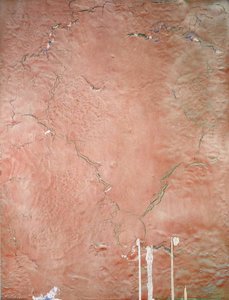
Sullivan’s formal training at the prestigious Rhode Island School of Design (RISD) provided the technical foundation necessary to execute his ambitious material experiments. It was during this formative period that he began to refine a signature technique involving the meticulous layering of resin. This process is far more than a decorative finish; it is an act of architectural construction. By manipulating resin, Sullivan is able to simulate organic and geological textures—ranging from the rugged grain of ancient wood to the translucent shimmer of crystalline structures. Through this method, he transforms the canvas into a topographical map of light and shadow, creating works that possess a palpable, physical presence.
A Synthesis of Minimalism and Expression
The aesthetic language of Sullivan’s oeuvre is deeply informed by the rigorous principles of Minimalism and the structural clarity of the Bauhaus movement. His compositions often rely on precise geometric configurations and a reductive approach to form, ensuring that every line and proportion serves a balanced, intentional purpose. Yet, within this controlled framework, there exists a vibrant, almost primal energy. This tension between disciplined geometry and expressive texture allows his work to resonate with the spirit of Abstract Expressionism, echoing the monumental color fields of masters like Mark Rothko while introducing a contemporary, sculptural dimension that is entirely his own.
One of his most profound achievements can be seen in large-scale works such as “October 6, 2011 October 20, 2011,” where a commanding crimson palette meets intricate blue and white patterns. In such pieces, the resin does not just add texture; it creates a sense of temporal depth, as if the viewer is looking through layers of time itself. This ability to capture fleeting moments or specific psychological states through the manipulation of physical matter marks Sullivan as a pivotal figure in modern abstract art.
Global Recognition and Lasting Legacy
The impact of Sullivan’s sculptural paintings has reverberated far beyond the borders of the United States, earning him a place in some of the world's most esteemed collections and institutions. His career is marked by significant milestones that underscore his rising importance in the art historical canon:
- Institutional Presence: His works are held in the permanent collections of legendary institutions, including the Museum of Modern Art (MoMA) in New York, the Los Angeles County Museum of Art (LACMA), and the San Francisco Museum of Modern Art (SFMOMA).
- Exhibition History: Sullivan has showcased his vision in prestigious global venues such as MoMA PS1, the Rubell Family Foundation in Miami, and the Palazzo delle Esposizioni in Rome.
- Residency Achievements: His dedication to artistic growth is evidenced by prestigious residencies at the Chinati Foundation in Marfa, Texas, and the Robert Rauschenberg Foundation in Florida.
As Sullivan continues to push the limits of what a painting can be, his legacy remains rooted in the pursuit of the material sublime. By treating resin as both a medium and a structural element, he has redefined the canvas as a site of sculptural innovation. His work stands as a testament to the power of hybridity, proving that when the boundaries between disciplines are blurred, new worlds of perception can be discovered.