
 Zobacz w skali 1:1
 Wyślij
 Udostępnij
 Szczegóły
 Przewodnik

 Pobierz plik obrazu
 Podobne obiekty
 RTG
RTG Pokaz slajdów
 Statystyki
Untitled


 Czytaj więcej
Dzieło sztuki prezentowane na tej stronie podlega ochronie prawem autorskim, co oznacza, że nie mamy prawa do tworzenia ani sprzedaży jego identycznej reprodukcji. Ochrona ta jest egzekwowana na mocy umów międzynarodowych, takich jak Konwencja berneńska oraz przez przepisy prawa krajowego, w tym te określone w Prawo autorskie USA – Tytuł 17.
Jako pełną szacunku i legalną alternatywę oferujemy personalizowane, malowane ręcznie dzieła sztuki inspirowane oryginałem. Nasi wykwalifikowani i profesjonalni artyści starannie analizują styl, nastrój oraz artystyczną esencję pierwowzoru, aby stworzyć nowe, unikalne dzieło, które przywołuje te same emocje – pozostając jednocześnie w pełni oryginalną kreacją.
Metoda ta jest w pełni zgodna z przepisami prawa autorskiego, ponieważ nie polega na kopiowaniu ani powielaniu chronionego dzieła. Stanowi ona kreatywną reinterpretację – nowy obraz, który czerpie inspirację z oryginału, ale nie jest z nim tożsamy.
Ręcznie malowana reprodukcja olejowa
Ręcznie malowany obraz olejny na płótnie, wykonany na zamówienie przez naszych artystów w wybranym przez Ciebie wymiarze i oprawie. ( Przełącz na wersję drukowaną Przełącz na wersję cyfrową)




P118B zł10

P118H zł10

P118W zł10

P438Z zł10

P508JH zł12

P508YH zł12

P805H zł10

P805Z zł10

P919BZ zł10

P919G zł10

P919XJ zł10

P959ZH zł10

P968JZ zł12

W106C zł8

W218G zł10

W218JH zł8

W218Y zł10

W307PJ zł10

W316G zł10

W316PJ zł8

W316Y zł10

W398PJ zł8

W4111J zł10

W500HY zł15

W500JH zł15

W692G zł12

W849H zł8

W940BG zł15

W953PJ zł8




Wybierz spośród naszych standardowych rozmiarów, które zachowują oryginalne proporcje dzieła sztuki.

Wpisz wymaganą szerokość i wysokość, aby obraz pasował do Twojej ramy lub ściany. Ponieważ jest to dzieło malowane ręcznie, w przypadku rozmiaru o innym proporcji artysta może domalować nieco więcej wokół obrazu lub przyciąć fragmenty — wybór należy do Ciebie. Przed rozpoczęciem pracy prześlemy Ci cyfrową wizualizację do zatwierdzenia. Obraz widoczny na tej stronie nie przedstawia rzeczywistego efektu — jedynie wizualizacja oddaje realny rezultat.
Po złożeniu zamówienia zespół WikiOO.org skontaktuje się z klientem drogą mailową w celu uzyskania instrukcji i prześle wizualizację projektu
Dostawa na całym świecie () w ciągu 3–4 tygodni zamiast standardowych 5 tygodni. (23 Październik). Bez kompromisów w kwestii jakości.

Bezpłatna ekspresowa wysyłka na cały świat

Wysokiej jakości płótno lniane

Pełne ubezpieczenie transportowe

Gwarancja zwrotu należności celnych i podatków importowych

Gwarancja idealnego odwzorowania barw

100-dniowy okres na zwrot dzieła w przypadku wykrycia wad produkcyjnych

Gwarancja 100% zwrotu pieniędzy

Oferta przy zakupie wielu sztuk
 Opcja ze szkłem jest dostępna wyłącznie w rozmiarach poniżej 110 cm

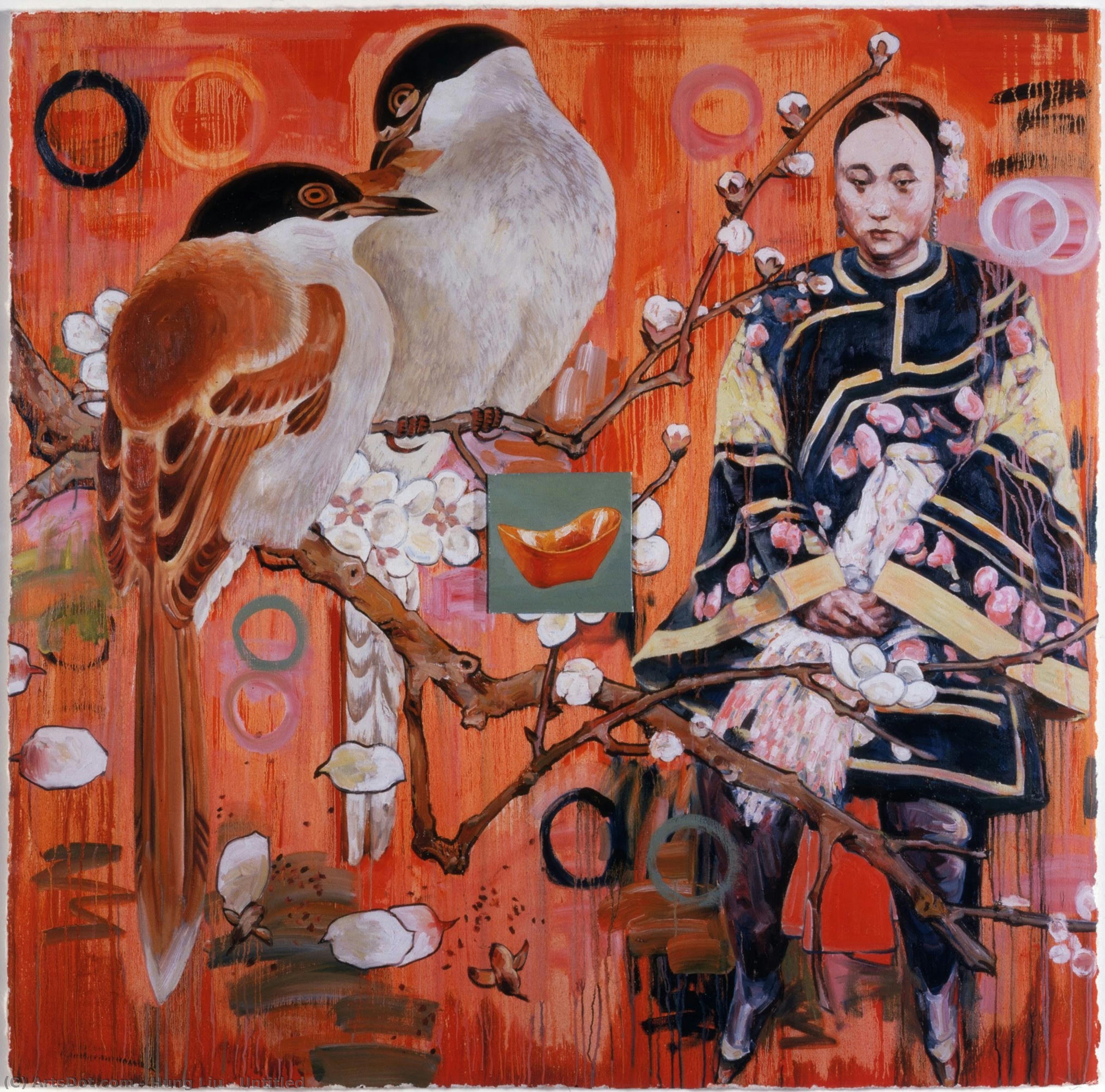
Untitled
Technika wykonania
Rozmiar reprodukcji
-


Suma do zapłaty
zł 1020
A Symphony of Resilience: Unveiling Hung Liu’s "Untitled"
In the quietude of Hung Liu’s 2004 masterpiece, "Untitled," one finds a profound dialogue between the delicate beauty of nature and the heavy echoes of human history. At first glance, the viewer is greeted by a vibrant, almost dreamlike tableau: two birds perched gracefully upon blossoming branches, set against a backdrop that feels both ethereal and grounded. The composition breathes with an Impressionistic vitality, where loose, sweeping brushstrokes allow colors to bleed into one another, creating a sense of movement as if a gentle breeze might stir the petals at any moment. Liu employs a masterful palette of ochre, crimson, and emerald green, utilizing oil paints to build layers of depth that capture the fleeting essence of a natural moment while simultaneously hinting at a much deeper, more melancholic narrative.
Beyond the surface level of botanical beauty, the painting serves as a poignant meditation on memory and displacement. To understand the emotional weight of this work, one must look to the artist’s own journey. Born in Changchun amidst the political tremors of 20th-century China, Liu’s life was shaped by the shadows of the Cultural Revolution and the personal trauma of her father’s imprisonment. This history of upheaval informs every stroke; there is a deliberate tension between the tranquil subject matter and an underlying sense of vulnerability. The birds, often utilized in Chinese iconography as symbols of hope and perseverance, stand as sentinels of strength amidst the blossoms of renewal. They represent the ability to find stability and growth even when the landscape of one's life has been irrevocably altered by revolution.
A Masterpiece for the Discerning Collector
For the art enthusiast or interior designer, "Untitled" offers a rare opportunity to possess a piece that transcends mere decoration. It is an artwork that demands contemplation, inviting the observer to look past the vibrant flora and engage with the themes of rebirth and endurance. The painting’s ability to harmonize bright, energetic tones with a subtle, soulful sadness makes it a versatile centerpiece for any sophisticated space. Whether placed in a sunlit gallery or a quiet study, the work radiates a quiet dignity that can anchor a room's aesthetic while providing a constant source of intellectual and emotional inspiration.
Investing in a high-quality reproduction of this work allows one to bring the legacy of Hung Liu into the home—a legacy defined by the courage to transform personal struggle into universal beauty. The interplay of light and texture within the piece ensures that it remains captivating from every angle, offering a window into a world where even the most turbulent histories can find expression through the timeless language of art. It is not merely a painting of birds and flowers; it is a testament to the enduring spirit of life itself.
Pytania i odpowiedzi
Do którego etapu rozwoju Hung Liu należy dzieło „Untitled”?
„Untitled” należy do Mature Period w twórczości Hung Liu. Klasyfikacja ta wiąże dzieło z rozwojem artysty.
Gdzie i w jakim celu zaleca się użycie "Untitled"?
Dzieło „Untitled” autorstwa Hung Liu jest polecane do Accent, najlepiej w Living Room. Zastosowanie oraz przestrzeń pomagają zdecydować, gdzie najlepiej umieścić reprodukcję.
W jaki sposób mogę obejrzeć „Untitled” autorstwa Hung Liu w formie pokazu slajdów?
Prezentację slajdów dzieła "Untitled" można obejrzeć na stronie Pokaz slajdów tego utworu.


Biografia artysty
A Life Forged in Revolution: The Early Years and Artistic Awakening of Hung Liu
Hung Liu’s story is inextricably linked to the tumultuous history of 20th-century China. Born in Changchun in 1948, her childhood unfolded under the shadow of a newly established communist regime and the subsequent political upheavals that would define an era. The imprisonment of her father for his past affiliations with the Kuomintang cast a long shadow, instilling within young Hung a sensitivity to injustice and the fragility of truth – themes that would resonate profoundly throughout her artistic career. Her move to Beijing at age ten, attending the prestigious Experimental High School Attached to Beijing Normal University, offered access to education but also immersion in an environment increasingly controlled by Maoist ideology. This period culminated in the Cultural Revolution, a decade of social and political chaos during which Liu was sent, like millions of other young people, for “re-education” through labor. From 1968 to 1972, she lived and worked among villagers in Huairou, experiencing firsthand the hardships and resilience of rural life. This experience wasn’t merely a period of enforced hardship; it was a formative encounter with humanity at its most vulnerable, an encounter that would later fuel her artistic vision. It was during these years, despite restrictions, that she secretly began to sketch and photograph those around her, acts of quiet rebellion and nascent artistic expression. These early experiences instilled in Liu a deep empathy for the marginalized and a critical perspective on official narratives – qualities that became hallmarks of her work.Weeping Realism: A Unique Artistic Language
Liu’s artistic style is instantly recognizable, a captivating blend of technical skill and emotional depth. Trained initially in Socialist Realism—a highly controlled and academic approach to art—she consciously rejected its rigid constraints, forging her own path that embraced both the formal rigor of her training and a deeply personal expressive voice. Her paintings are characterized by layered brushstrokes combined with generous washes of linseed oil, creating a distinctive “drippy” effect that lends an ethereal quality to her subjects. This technique isn’t merely aesthetic; it's symbolic. The dissolving forms and blurred edges evoke the passage of time, the erosion of memory, and the inherent instability of historical narratives. Her partner, critic Jeff Kelley, aptly described this style as “weeping realism,” capturing the sense of melancholy and loss that permeates much of her work. From the mid-1980s onward, Liu began incorporating found photographs—primarily 19th and early 20th-century images of Chinese individuals—into her paintings. These weren’t simply reproductions; they were starting points for a process of reimagining and recontextualization. She often focused on marginalized figures – prostitutes, laborers, refugees – those whose stories had been overlooked or silenced by official histories. Liu believed she was “giving a spirit” to these forgotten individuals, imbuing them with dignity and agency through her art. The use of linseed oil, in particular, created a sense of vulnerability and decay, mirroring the fragility of memory and the passage of time.Themes of Memory, Migration, and the Human Condition
Hung Liu’s work consistently grapples with profound themes of memory, migration, identity, and the human condition. Her exploration of historical photographs wasn't simply an aesthetic choice; it was a deliberate engagement with questions of truth, representation, and power. By appropriating these images, she challenged their original context and invited viewers to reconsider the stories they told. Her *American Exodus* series, inspired by Dorothea Lange’s iconic photographs of the Dust Bowl era, demonstrates her ability to translate her concerns about displacement and hardship to an American context. Similarly, her *Strange Fruit* paintings addressed the horrific experiences of Korean “comfort women” forced into sexual slavery during World War II, a subject rarely acknowledged in mainstream historical narratives. Liu's own experience as an immigrant profoundly shaped her artistic vision. She understood firsthand the complexities of navigating new cultures, the challenges of belonging, and the enduring power of memory. Her work often explores the tension between assimilation and preservation of cultural identity, reflecting her own journey from China to America. The layering of photographic elements with brushstrokes created a dialogue between the past and present, suggesting that history is not simply a collection of facts but a living, breathing process shaped by individual experiences.From Socialist Realism to Personal Vision
Initially trained in the strict conventions of Socialist Realism—a style emphasizing idealized portrayals of socialist life—Liu gradually moved away from this prescribed aesthetic. While she retained a technical proficiency honed during her formal education at the Central Academy of Fine Arts in Beijing, she began to infuse her work with a more personal and expressive sensibility. This shift was partly influenced by her time in America, where she encountered contemporary art practices that challenged traditional notions of representation. Her studies under Allan Kaprow, an American pioneer of Happenings, exposed her to new approaches to artistic engagement and encouraged experimentation with mixed media and installation techniques. The influence of artists like Lorna Simpson and Carrie Mae Weems, whom she studied alongside at UC San Diego, further broadened her conceptual horizons. Liu’s work became increasingly concerned with the complexities of identity, memory, and social justice—themes that resonated deeply with her own experiences as a Chinese immigrant navigating American society.Legacy and Recognition
Hung Liu's contributions to contemporary art are significant and far-reaching. She was a pioneer in bridging Eastern and Western artistic traditions, bringing a unique perspective informed by both Chinese history and American experience. She was among the first artists from China to achieve international recognition, paving the way for future generations of Chinese artists working on the global stage. Her work has been exhibited extensively and collected by prestigious museums worldwide, including the San Francisco Museum of Modern Art, the Whitney Museum of American Art, and the Metropolitan Museum of Art. Liu’s legacy extends beyond her individual artworks. She challenged conventional notions of history painting, expanded the possibilities of photographic appropriation, and created a powerful visual language for exploring themes of memory, migration, and social justice. Her art continues to resonate with audiences today, offering a poignant reminder of the importance of remembering the past and honoring the stories of those who have been marginalized or forgotten.
Hung Liu
1948 - 2021 , Chiny
Najważniejsze informacje
- Artistic Movement Or Style: Realizm płaczący
- Artists Or Movements Influenced By This Artist: ['Dorothea Lange']
- Artists Who Influenced This Artist: ['Socialist Realizm']
- Date Of Birth: 1948-02-17
- Date Of Death: 2021-08-07
- Full Name: Hung Liu
- Nationality: Chiński-Amerykański
- Notable Artworks:
- Women Working
- Resident Alien
- Strange Fruit
- Place Of Birth: Changchun, Chiny
Zobacz także powiązane artykuły

Trwała Spuścizna Malarstwa Olejnego: Technika, Historia i Estetyczny Wpływ
Poznaj historię i technikę malarstwa olejnego! Eksperckie artykuły o konserwacji, renowacji oraz współczesnych zastosowaniach. Dowiedz się więcej o mistrzach i trwałości obrazów olejnych.

The Soul of Impressionism: Why Oil on Canvas Captures Eternal Light and Timeless Emotion
Discover the enchanting alchemy of Impressionism. Explore how the mastery of oil on canvas, through glazing and impasto, captures eternal light and emotion. Perfect for lovers of Monet and Van Gogh seeking the profound depth of hand-painted fine art.

Impresjonizm vs Postimpresjonizm: Ekskluzywny Przewodnik po Rewolucji Światła i Emocji w Malarstwie
Odkryj fascynującą różnicę między impresjonizmem a postimpresjonizmem. Poznaj historię rewolucji światła i emocji poprzez luksusowe, ręcznie malowane reprodukcje mistrzów w WikiOO. Ekskluzywna jakość, tradycyjne techniki olejowe i profesjonalne doradztwo dla koneserów sztuki.

Paul Cézanne: 25 Arcydzieł, które Zrewolucjonizowały Świat Sztuki | WikiOO
Odkryj 25 arcydzieł Paula Cézanne'a – od impresjonizmu po postimpresjonizm. Poznaj historie, techniki i inspiracje malarza, który zrewolucjonizował sztukę. Reprodukcje obrazów najwyższej jakości na WikiOO.org!

Olej na płótnie: Historia, techniki i ponadczasowy urok malarskiego medium
Poznaj historię i techniki malarstwa olejowego! Od renesansowych mistrzów po współczesne zastosowania – wszystko o oleju na płótnie. Poradniki, konserwacja i inspiracje dla pasjonatów sztuki.

