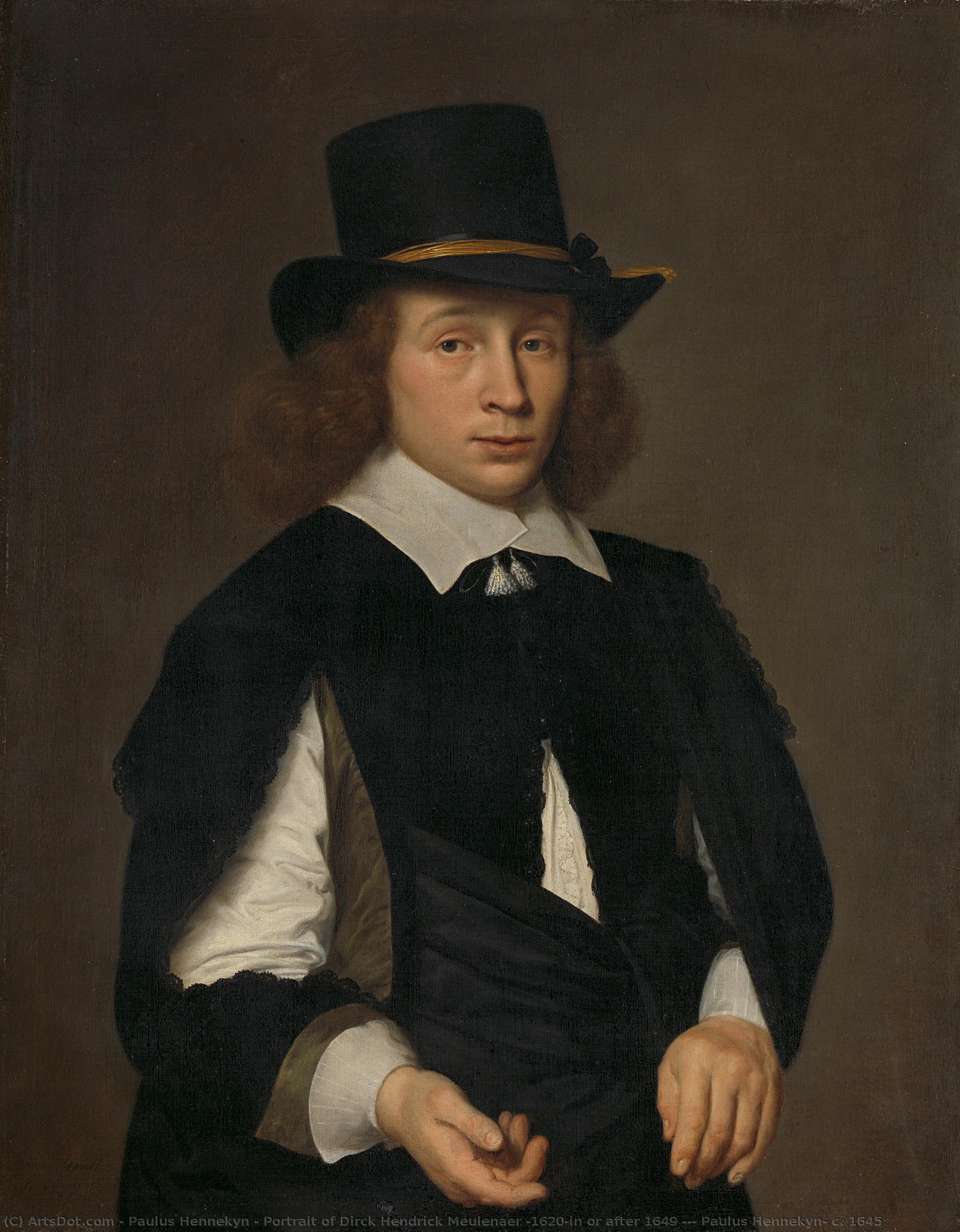
Artist: Paulus Hennekyn
Date: 1645
Size: 88 x 69 cm
Technique: Oil On Canvas
Since its first mention in the literature in 1880 the signature on this portrait of a man standing at half length was read as ‘Jan v. Hemert’, a totally fictitious artist, until conservator Michel van de Laar deciphered it as ‘Paulus Hennekyn’ in 2010. The date is hard to read, and the third numeral is now completely illegible, but as the sitter’s costume is in the fashion of the mid-1640s the painting was most probably executed by 1645.6 The identification of the sitter as Dirck Hendrick Meulenaer was probably derived from the inscription on the back of the canvas. The painting presumably acquired its present lining, which looks modern, after its arrival in the museum in 1880, and it stands to reason that the text on the reverse was then copied from the original support, which seems to be confirmed by the – slightly different – transcription in the 1880 collection catalogue.7 The figure’s identity could certainly be correct, since the Van de Poll Bequest, of which the picture was part, contained more likenesses of members of the Meulenaer family.8 It is no longer possible to reconstruct the route by which the portraits passed by descent to Van de Poll. Dirck Hendrick Meulenaer was baptized in the Oude Kerk in Amsterdam on 11 June 1620.9 The related certificate lists Hendrick Dircksz Meulenaer and Annetje Harmensdr as his parents, which is in full compliance with the inscription on the reverse and the mention in the 1880 collection catalogue. The couple became betrothed on 9 November 1601 in Amsterdam, where Hendrick worked as a shoemaker.10 He was buried in the Oude Kerk on 18 September 1638, and Annetje followed on 4 October 1645. Roelof Meulenaer, whose portrait by Ferdinand Bol is also in the Rijksmuseum,11 was an elder brother of the here depicted Dirck. The biographical information about the latter is sparse. He is probably the Dirck Meulenaer who is documented as a junior merchant in Nagasaki from November 1646 to November 1649.12 If so, this painting was made just before he left for Asia, and the journey could have been the reason for commissioning it. Meulenaer may have died in Japan at an early age, for there are no later references to him in either the Dutch East India Company (VOC) archives or those in Amsterdam. Meulenaer is snappily dressed with a hatband of gold thread over a black silk ribbon. He is wearing a black doublet, trimmed with bobbin lace from Genoa,13 of which a slit in the sleeve reveals its green silk lining and his shirt of spotless white linen. He has slung his cloak around his body. The hand gesture could indicate that he is speaking.14 A slightly earlier example is found in Thomas de Keyser’s 1632 Portrait of a Man,15 and Hennekyn could also have borrowed it from likenesses by Bartholomeus van der Helst, with whom he is known to have been in touch.16 The lively composition, with the body slightly off balance, was quite new at the time and remained an exception in Hennekyn’s oeuvre. He and his clients preferred a restrained style, with a faithful resemblance being the prime requirement, together with care being lavished on a convincing rendering of the textures of the clothing. This portrait is a good illustration of that. Eddy Schavemaker, Jonathan Bikker, 2022 See Key to abbreviations, Rijksmuseum painting catalogues and Acknowledgements
Artist |
|
|---|---|
Download |
|
Permissions |
Free for non commercial use. See below. |
 |
This image (or other media file) is in the public domain because its copyright has expired. However - you may not use this image for commercial purposes and you may not alter the image or remove the watermark. This applies to the United States, Canada, the European Union and those countries with a copyright term of life of the author plus 70 years.
|
 Note that a few countries have copyright terms longer than 70 years: Mexico has 100 years, Colombia has 80 years, and Guatemala and Samoa have 75 years. This image may
not be in the public domain in these countries, which moreover do not implement the
Note that a few countries have copyright terms longer than 70 years: Mexico has 100 years, Colombia has 80 years, and Guatemala and Samoa have 75 years. This image may
not be in the public domain in these countries, which moreover do not implement the
